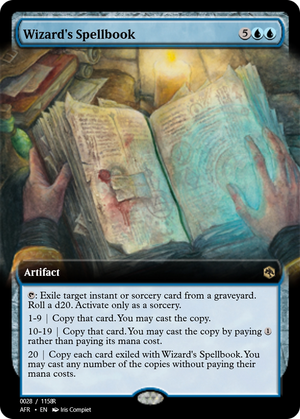
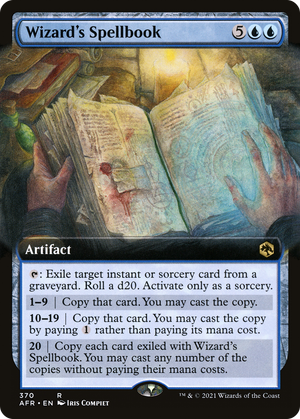
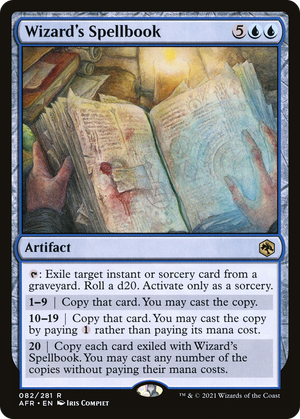
Wizard's Spellbook


The tension here is between a graveyard-recursion engine and a die roll, and the design commits fully to the randomness: on the low rolls you recur a spell at full cost, which is a slow, expensive way to buy back a Divination. The middle band, the discount, is where the artifact starts paying for itself, and the natural 20 is the payoff the whole shell is built around, casting every card ever exiled with it for free at once. What makes the die interesting is that the machine banks its own fuel: each activation exiles another spell to the artifact, so the pool of what a 20 copies grows every turn you keep tapping it. That converts the design from a one-shot recursion effect into an accumulator, where the correct play is to keep feeding it cheap spells and wait for the top of the range to convert the stockpile into a blowout. The sorcery-speed clamp on the activation is doing real work: an instant-speed version of this would let you fish for the 20 on the opponent's end step with no downside, so the restriction forces the whole gamble onto your own turn, where the tempo cost of tapping a seven-mana artifact and drawing a 3 actually stings. It is a variance engine dressed as a value engine, and whether it is one or the other depends entirely on the twenty-sided die.
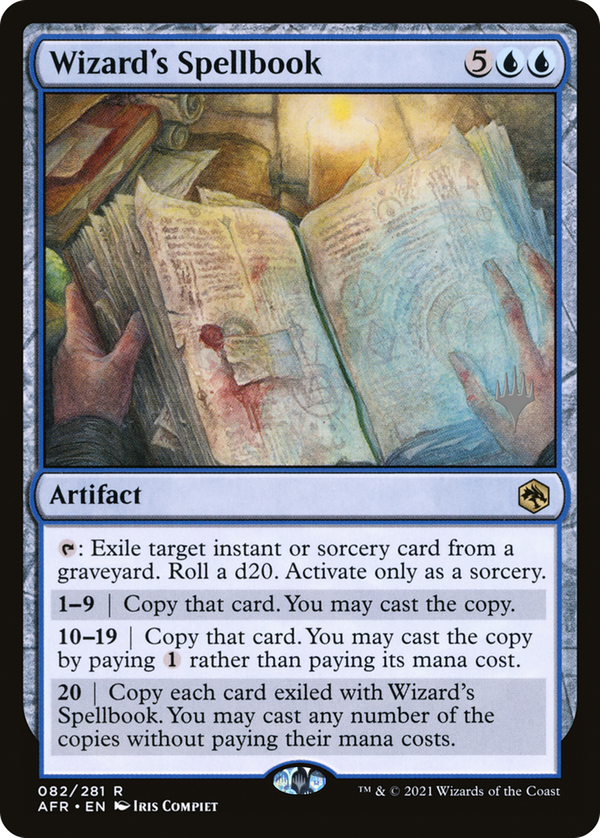
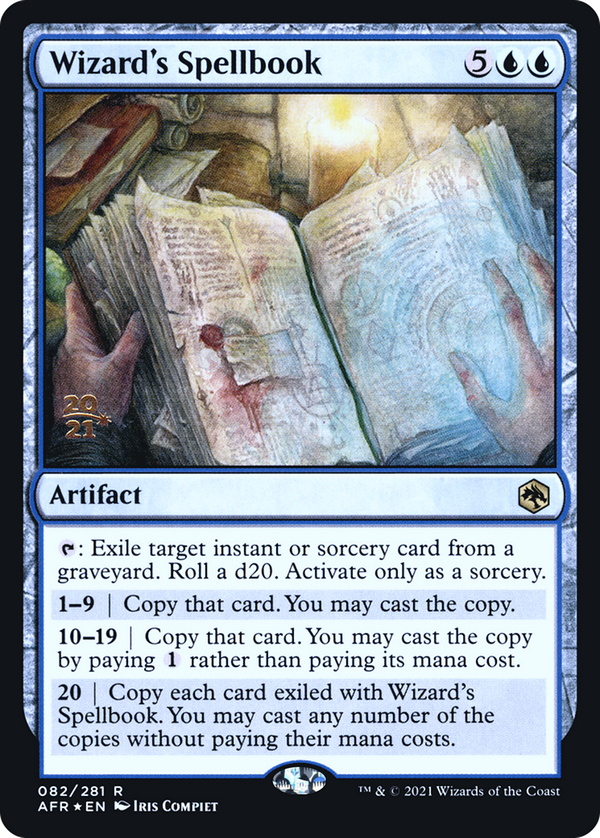
Rules text
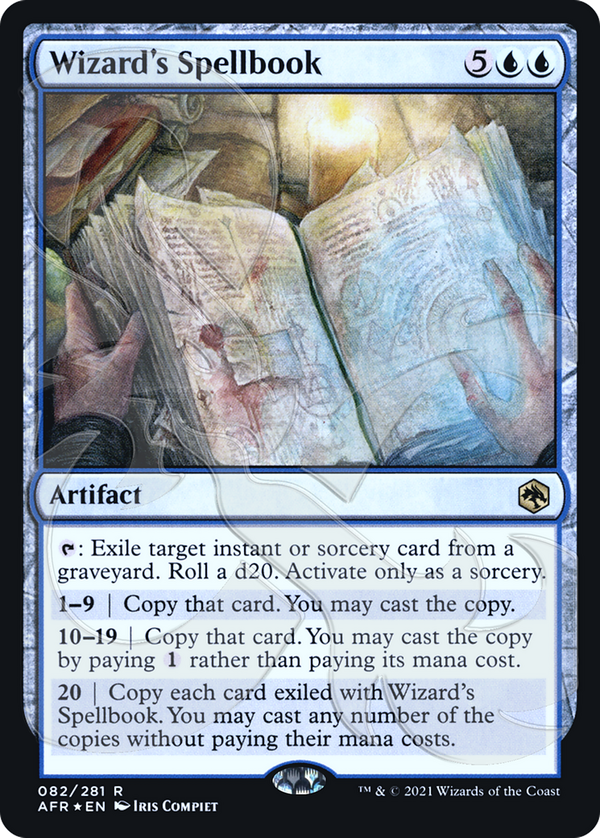
 : Exile target instant or sorcery card from a graveyard. Roll a d20. Activate only as a sorcery.
1—9 | Copy that card. You may cast the copy.
10—19 | Copy that card. You may cast the copy by paying
: Exile target instant or sorcery card from a graveyard. Roll a d20. Activate only as a sorcery.
1—9 | Copy that card. You may cast the copy.
10—19 | Copy that card. You may cast the copy by paying  rather than paying its mana cost.
20 | Copy each card exiled with this artifact. You may cast any number of the copies without paying their mana costs.
rather than paying its mana cost.
20 | Copy each card exiled with this artifact. You may cast any number of the copies without paying their mana costs.