Viashino Sandswimmer


Coin flips were a recurring red bargain in the game's early years: power offered with a randomizer bolted on, and this is that bargain pushed to its self-defeating extreme. The body is fragile enough that you want a way to keep recasting it, and the only escape valve is the creature itself, wagering its own survival every time you pay to fire the ability. Win the flip and it bounces home, ready to be replayed or to dodge a removal spell already on the stack; lose and it goes straight to the graveyard, the very fate you were paying to avoid. That is the wager written into the slot: the activation works as an evasion-from-targeted-removal hatch, but only by making the protection a fifty-fifty gamble that can kill the card faster than any opponent will. The activation is both your escape route and your liability at once, and chaining multiple flips compounds the danger geometrically rather than smoothing it out. It sits alongside red's other variance experiments (Goblin Bookie, Krark's Thumb, and the broader coin-flip subtheme Magic has revisited every few years), where the flavor of impulsive, reckless red lives in the rules text rather than the art. The honest read is that the variance never earns its keep: a 3/2 for four whose entire survival plan is a coin toss demands more from the format than it ever returns. A flavor win and a rate loss, which was the whole bargain the coin-flip cycle was selling.
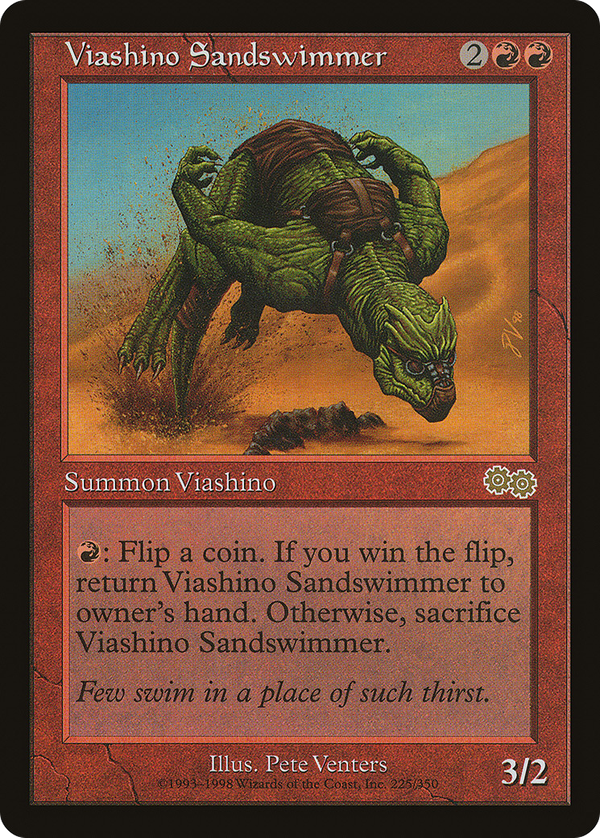
Rules text
: Flip a coin. If you win the flip, return this creature to its owner's hand. If you lose the flip, sacrifice this creature.