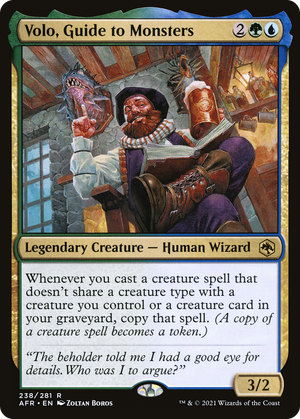
Volo, Guide to Monsters



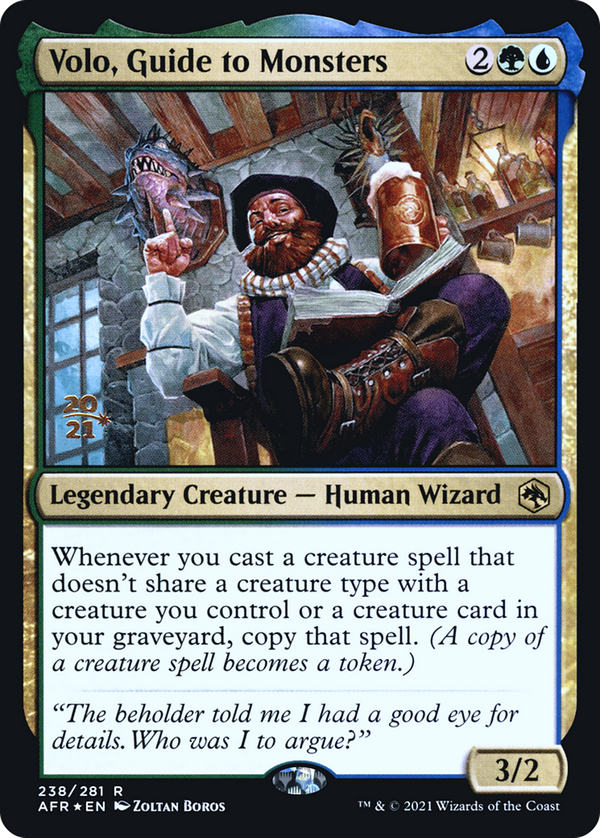
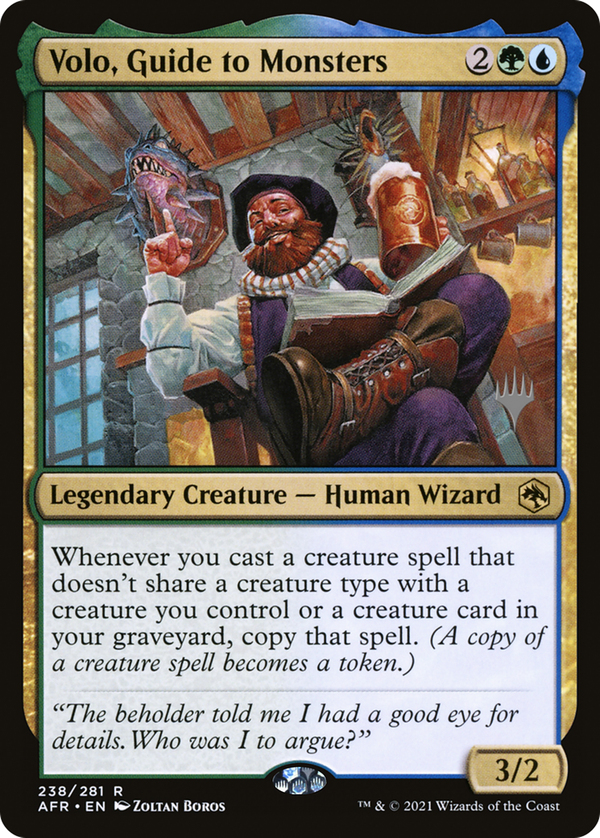
The reward it prints is a spell copy, and what buys it is a deckbuilding puzzle wearing a triggered ability. To fire, each creature you cast has to introduce a type you have not already touched: nothing sharing a type with a creature you control, and nothing sharing a type with a creature in your graveyard. That graveyard clause is the sharp edge. Most tribal payoffs reward you for piling copies of one type; this inverts the incentive entirely, punishing repetition and asking for a toolbox of singletons whose type lines never collide. It also fences off its own controller: because this is a Human Wizard sitting on the battlefield to trigger, no Human and no Wizard you cast will ever copy while it is out, which quietly bans two of the deepest type pools in the game from your doubling engine. The result reads like the opposite of a synergy deck: a lone Bird, a stray Elk, a single Beast, each cast doubling only if you have kept your creature base a spread of one-ofs rather than a stack of fours. The 3/2 body is beside the point; the real tax is variety, and the friction of tracking every type among the creatures you control and in your graveyard is the price of every copy. Where the rest of the tribal canon counts toward a keyword, this one counts against itself, an engine that runs on the diversity of your deck rather than its density.