Visions of Dominance


The doubling math is the whole engine, and it scales in a way linear counter effects never do: cast it on a creature carrying five counters and you leave it with twelve, not seven, because the added counter is inside the multiplier. That exponential curve rewards front-loading, so the card wants a target already stacked high rather than a fresh body. The flashback clause is the more pointed piece of design. Rather than a fixed graveyard cost, the reduction reads off the largest commander you own, which ties the second casting directly to how top-heavy your command zone is. A commander in the seven-or-eight range collapses that  into something routine, while a low-cost general leaves the flashback closer to unpayable. It is a deliberate inversion of the usual flashback tension, where the exile-after-cast is the price; here the price floats, keyed to a resource that lives outside the graveyard entirely and can be measured from the command zone before the card is ever in play. The result is a counters payoff built specifically for the singleton-general format, one that hands its biggest reward to decks whose commander already costs the most to cast.
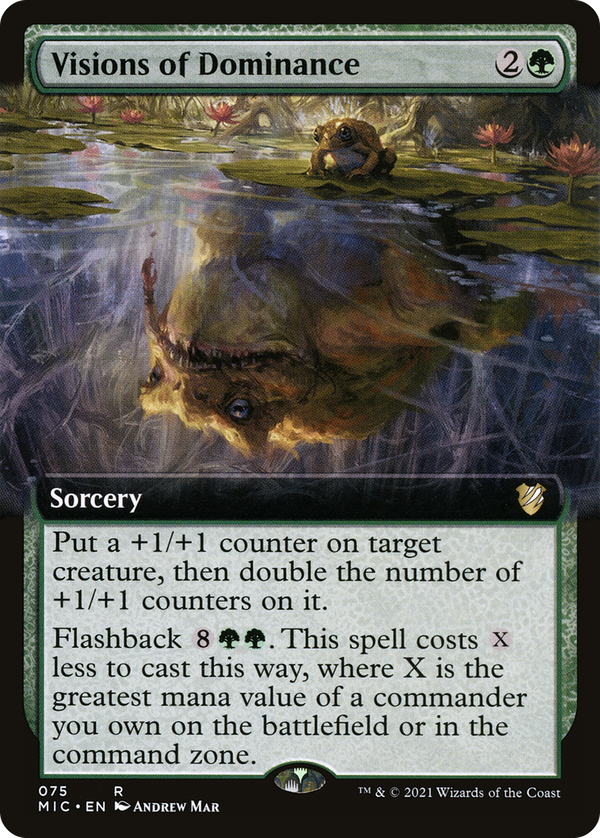
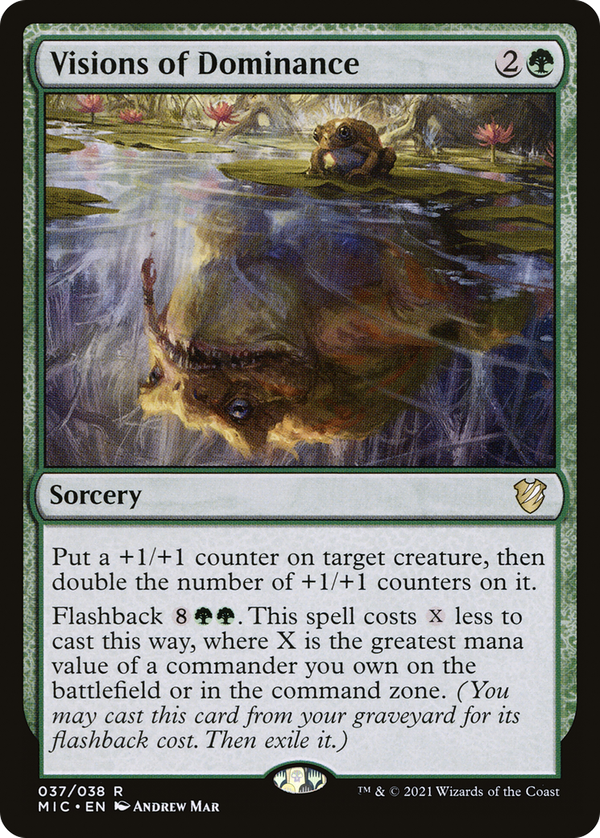
Rules text
. This spell costs  less to cast this way, where X is the greatest mana value of a commander you own on the battlefield or in the command zone. (You may cast this card from your graveyard for its flashback cost. Then exile it.)