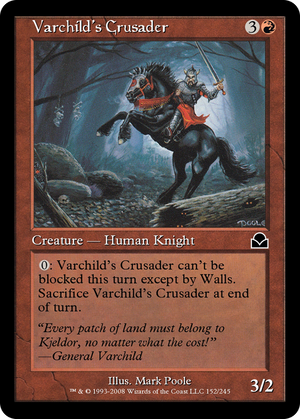
Varchild's Crusader


The free activation reads as pure upside until you notice the catch: spending it costs you the creature when the turn ends. The card frames evasion as a one-shot transaction. You point the 3/2 at an open board, swing for a guaranteed three (nothing but Walls can interpose), and then hand the body back. That self-destruct clause is the entire balancing mechanism. Without it the ability would be an absurd rate; with it, the Crusader is a Knight that can punch through exactly once before retiring, which is why the activation costs nothing at all. The Walls exception is the period detail. In an environment where defensive Walls were a real archetypal presence, "can't be blocked except by Walls" is a hedge against printing strictly free evasion, a small concession to the format's designated blockers rather than the universal "can't be blocked" later cards would offer. The design instinct on display is the one cards like Evoke and Dash would later formalize: trade permanence for a single burst of tempo and make the spend irreversible. Here the irreversible part is the sacrifice, and the lever is a zero-cost activation you can hold until the turn the extra three damage actually closes something out. The interesting wrinkle is the decoupling: the body sticks around as an ordinary attacker until you decide to cash it in, so the player owns both the timing and the price.
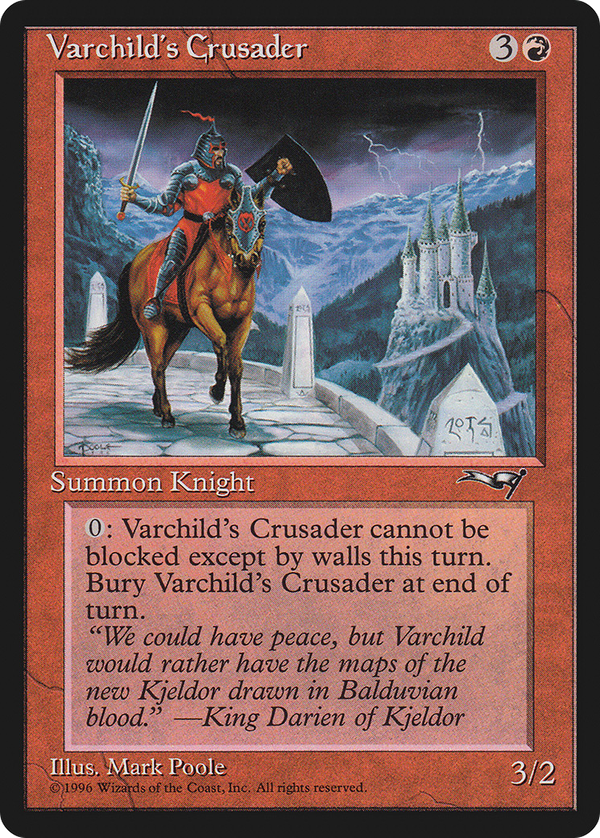
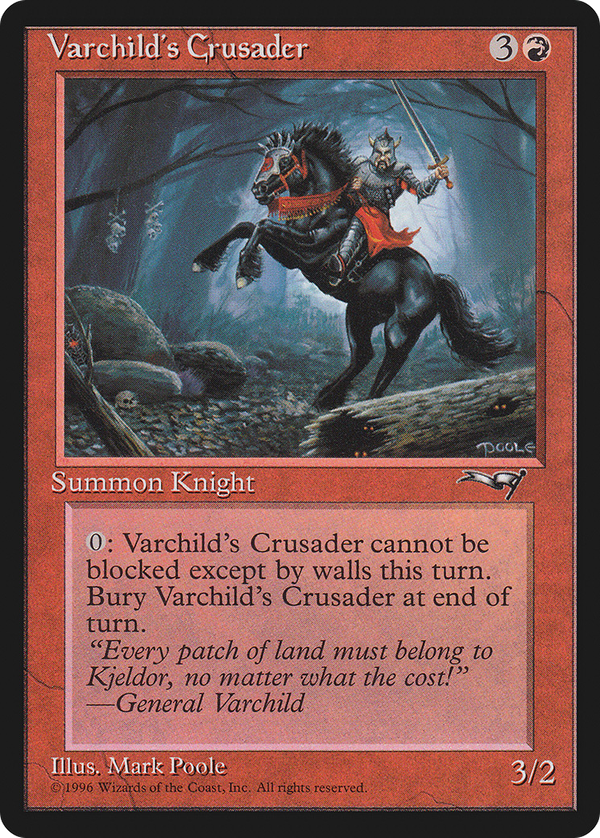
Rules text
 : This creature can't be blocked this turn except by Walls. Sacrifice this creature at the beginning of the next end step.