Twisted Landscape
The lesson of the tapland fetch is that fixing wants an escape hatch, and this one carries three exits from a dead draw. It comes down untapped, but it only produces colorless, so it is not fixing you on the turn it lands; its real job is the sacrifice ability, hunting up a basic Swamp, Mountain, or Forest and putting it onto the battlefield tapped, stitching together the Jund colors while thinning the deck by a card. The delay lives on the fetched land, not the source: you can crack it the moment you tap it, and the land it finds enters tapped, so the tempo you pay for a three-color fetch that spills no life is a single turn of the retrieved land sitting idle. The cycling clause is what redeems the late-game draw. When the lands you need are already down and the colorless is worthless, the three-pip cost turns the whole thing into a cantrip. And that cost is the constraint doing quiet work: you can only bail once your board is producing all three colors anyway, so the option to draw arrives priced exactly when the fixing has already done its job. It is the same flood insurance the old cycling lands ran, welded onto a fetch body, which makes it a mana-smoother that happens to fix rather than a fixer that happens to cycle.
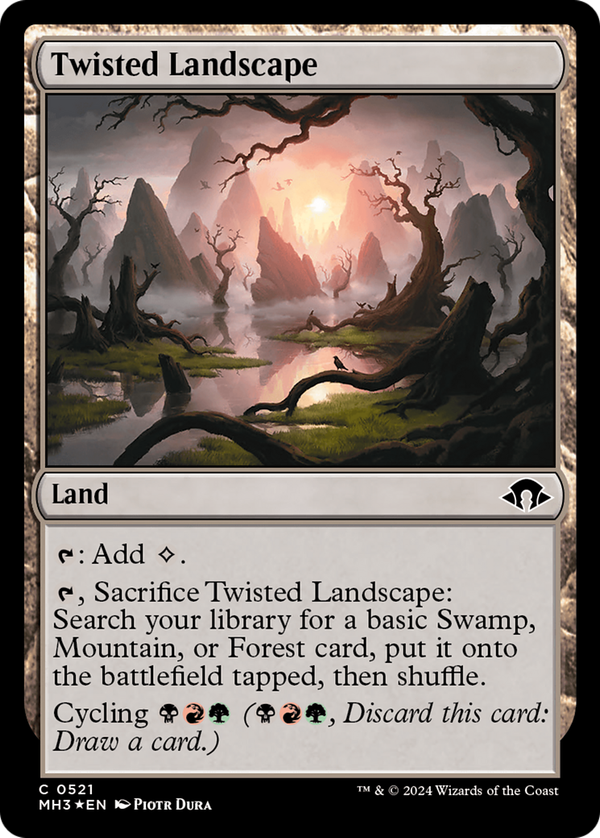
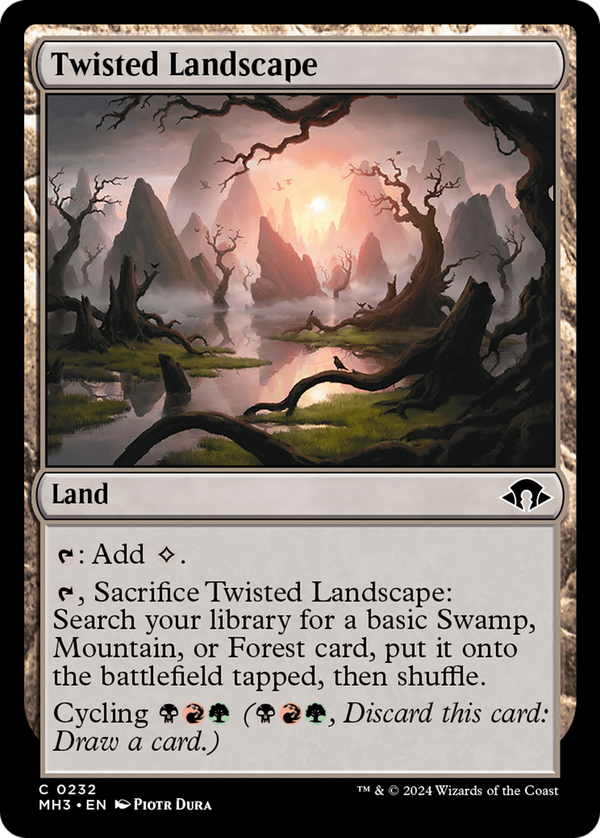
Rules text
 : Add
: Add  .
, Sacrifice this land: Search your library for a basic Swamp, Mountain, or Forest card, put it onto the battlefield tapped, then shuffle.
Cycling
.
, Sacrifice this land: Search your library for a basic Swamp, Mountain, or Forest card, put it onto the battlefield tapped, then shuffle.
Cycling 

 (, Discard this card: Draw a card.)