Treason of Isengard


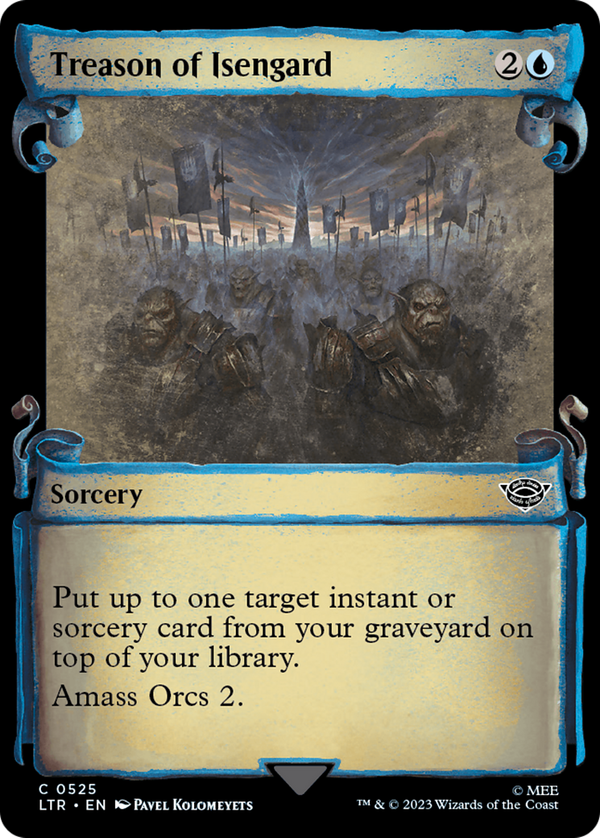
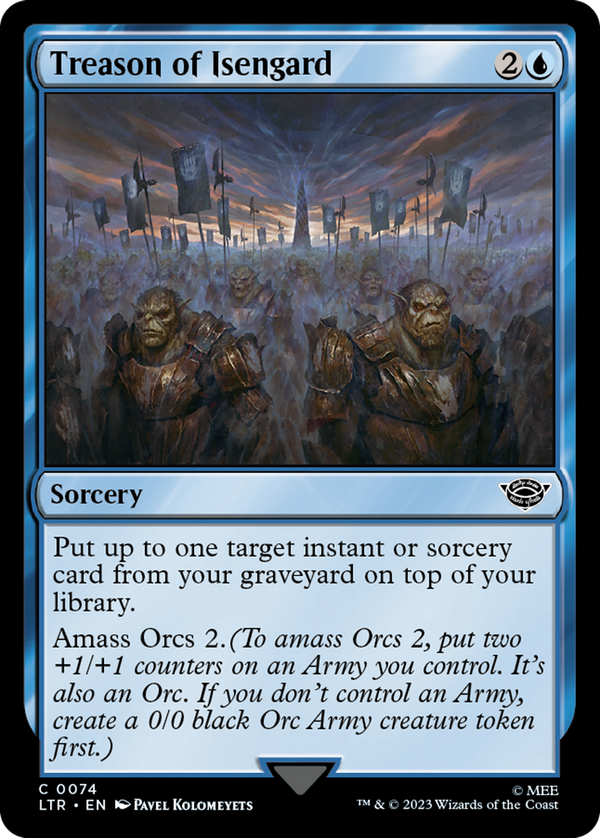
What the sorcery buys for its price is a spell you already spent, set back on top of your library to draw next turn. That is the design tension worth watching: buyback via the library, not the hand, means the recurred spell sits a full draw step away and taxes your card flow before it pays out. In a color that regularly wants to replay a counterspell, a bounce, or a burst of card advantage, that delay is the whole cost, and it keeps the effect from spiraling. The Amass Orcs 2 rider is the odder half. Stapling a board-development clause onto blue graveyard recursion is not a natural pairing; blue rarely wants to be growing an Army token while it recurs value, and Amass belongs mechanically to the black-and-red aggressive shell where it lives. The clause reads as a mode you take incidentally rather than one you build toward: two counters on an existing Army are meaningful, a lone 2/2 Orc alongside a returned instant is a footnote. What the card actually is, then, is a value spell that happens to leave a body, aimed at a deck that wants both graveyard reuse and a slow accumulation of tokens. When those two axes overlap, the card does two things at once; when they do not, you are paying three mana to re-buy a spell and accepting the Orc as change.