Thieves' Auction


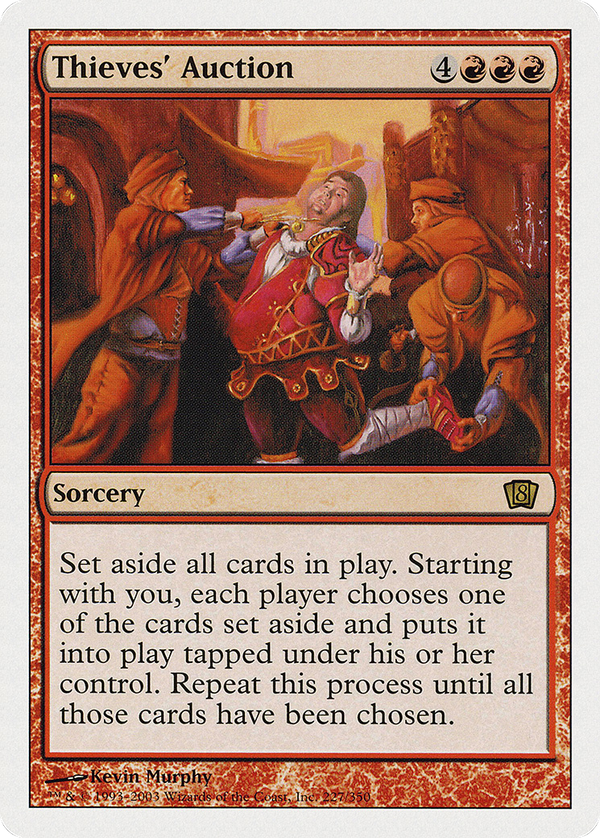
The most chaotic redistribution effect ever stamped onto a single sorcery, and it works by collapsing the entire notion of ownership. Wraths erase the board; this one shuffles it and deals it back out. Every nontoken permanent in play, lands and artifacts and creatures and enchantments alike, goes to exile, and then the table drafts the whole pile back onto the battlefield one card at a time. The selection order is the whole game: you pick first, but you pick once per round, so the player who chooses last gets the final look at what remains. There is no targeting, no choosing which of your own things survive, no way to shelter a key permanent. You are gambling that the redistribution favors you more than it favors the opponents who also get to fish your best cards out of the common pool. The repeated-selection structure is what makes it nearly unplayable as a real plan: it is symmetrical to the point of randomness, a button that detonates the game state and hands you no guaranteed advantage on the other side. It comes out of a design sensibility that prized splashy, group-altering spectacle over clean asymmetry, and it survives as the platonic example of a card you cast to find out what happens rather than to win.