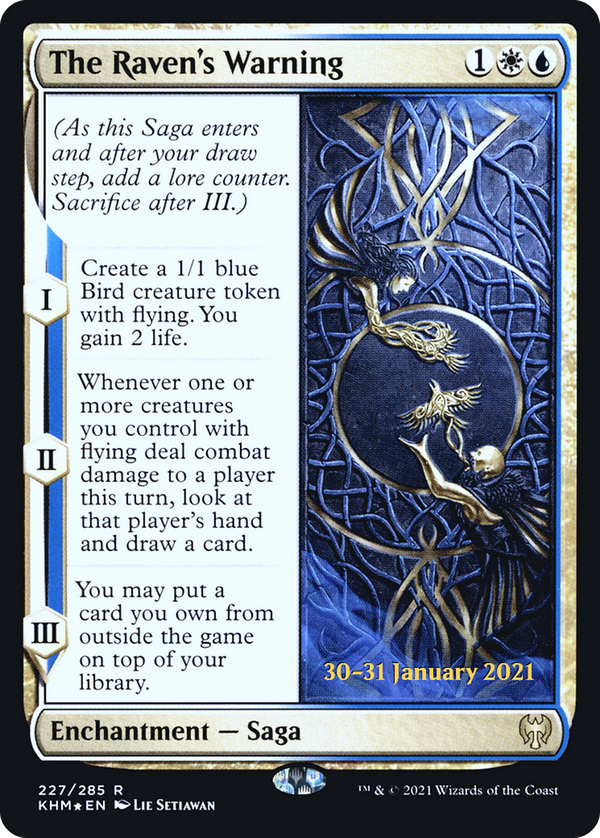
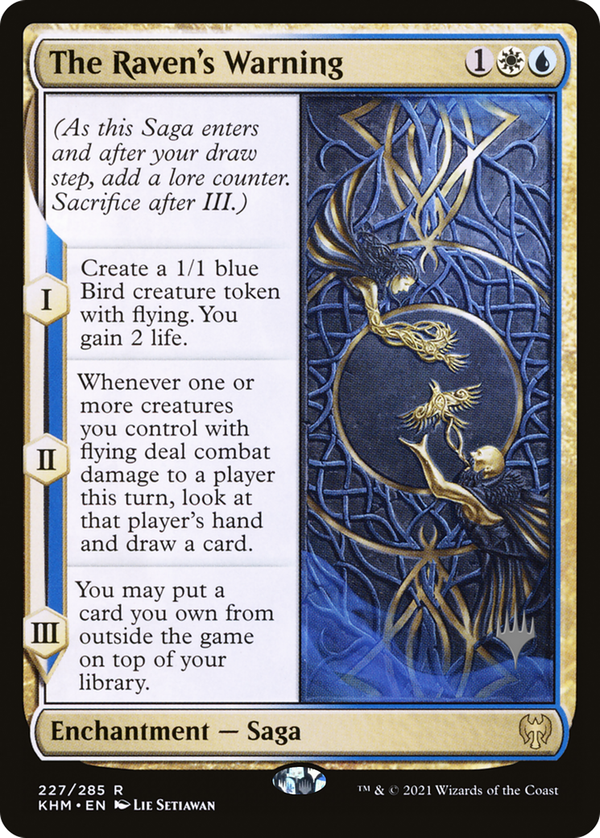
The Raven's Warning



That third chapter is what people remember: the "outside the game" clause, a wish-style tutor that otherwise lives almost exclusively on Learn cards and the old Wish cycle, tucked onto the back of a two-color value engine. The front half reads as pure combat glue: a Bird token and two life to stabilize on I, a card-draw payoff on II that also peeks at the opponent's hand whenever your fliers connect. Then III arrives and the card quietly stops being a value engine and becomes a sideboard toolbox that some tables have no way to interface with. The friction is structural. Sagas advance on their own clock, one lore counter after each of your draw steps, so the tutor is locked in on a fixed schedule (I the turn it enters, II the next turn, III the turn after) with no way to accelerate it, and the fetch only works if you have an "outside the game" pool to pull from, which not every format maintains. What makes the design sing is that its ceiling and floor are set by the format's rules rather than by the card's own numbers: the same clause is a construction in one room and a dead line in another.