The Magic Mirror


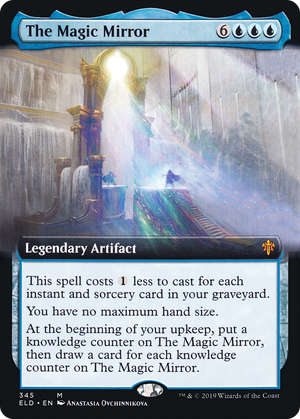
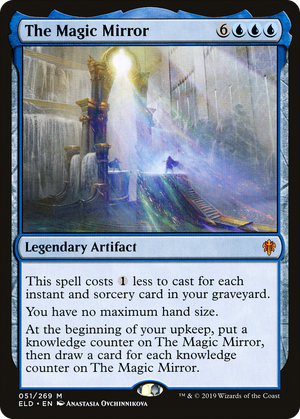
The nine-mana price tag is a fiction the card writes for itself: fill a graveyard with instants and sorceries and the cost caves inward, one generic mana at a time, until a control deck that has already spent a game answering threats gets to cash its spent spells a second time. That is the real design idea here, a mana cost that indexes to how much you have already done, so the reward scales with the exact kind of deck that wants a payoff. Once it resolves, the escalation is brutal in the most deliberate way: a knowledge counter arrives each upkeep before the draw, so the card refills one card, then two, then three, an arithmetic curve that turns a single unanswered turn into a hand no removal spell can catch up to. The no-maximum-hand-size clause is not a footnote; it is the load-bearing beam that keeps all those cards, because a draw-seven-then-more engine that made you discard would collapse under its own success. What sets it apart from the long line of blue card-advantage finishers is that it does not tick down or exile itself or ask for a payment: it only accelerates. The one mercy is the timing. Because the counter and draw fire together at the beginning of your upkeep, the whole machine sits exposed on the battlefield between turns, and an opponent has a full window to break it before the count runs away. Leave it alone one turn too long and the game is already decided in the graveyard math.
Rules text
 less to cast for each instant and sorcery card in your graveyard.
You have no maximum hand size.
At the beginning of your upkeep, put a knowledge counter on The Magic Mirror, then draw a card for each knowledge counter on The Magic Mirror.
less to cast for each instant and sorcery card in your graveyard.
You have no maximum hand size.
At the beginning of your upkeep, put a knowledge counter on The Magic Mirror, then draw a card for each knowledge counter on The Magic Mirror.