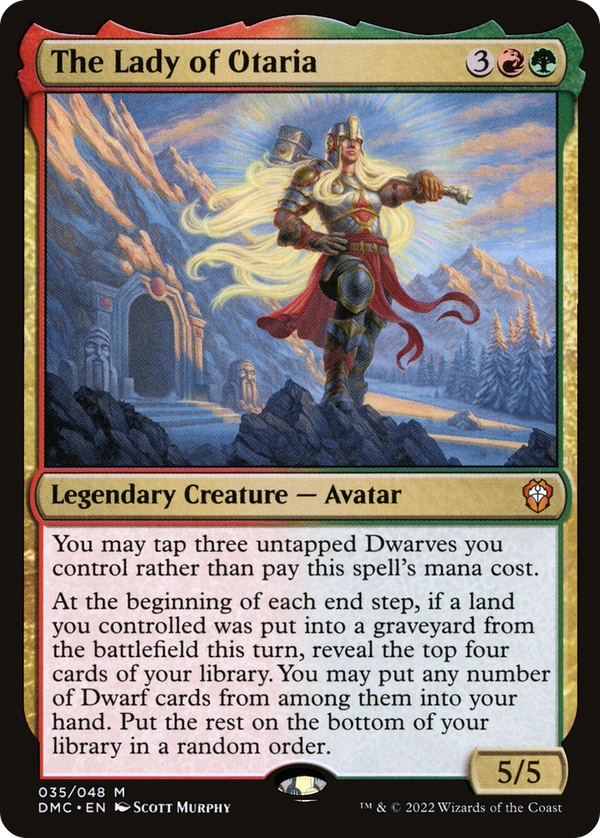
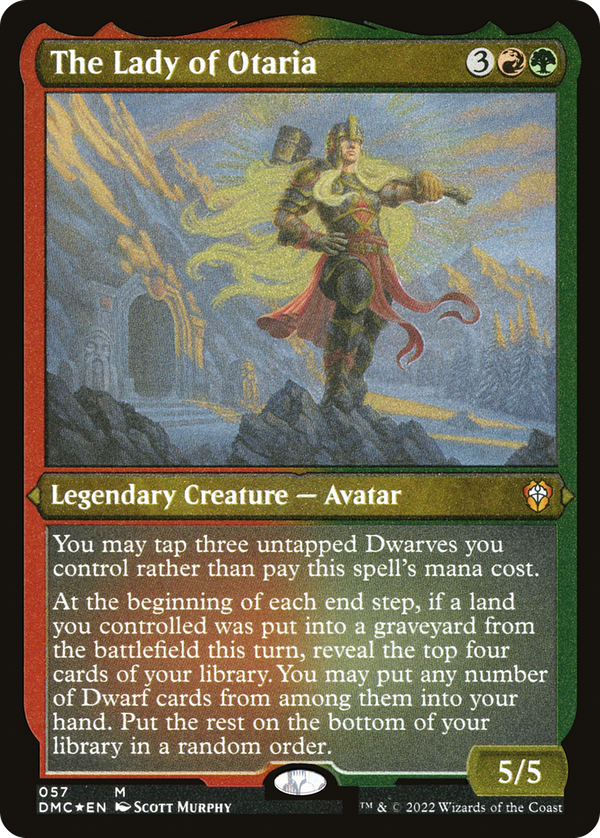
The Lady of Otaria



The alternative cost is the whole reason this design exists: tapping three Dwarves to skip a five-mana bill turns a build-around into a leader that arrives well ahead of curve for a tribe that had spent most of its history as a scattered afterthought across sets. That convergence of Dwarf payoff and land-sacrifice reward is deliberate. Sacrificing your own lands is a downside almost everywhere else; here it becomes a trigger condition, converting the loss into card selection. The end step checks once, regardless of how many lands you fed the graveyard that turn, and if any qualified, it digs four deep for Dwarves. That once-per-turn ceiling shapes the deck around it: the reward is capped, so you want the trigger firing every turn rather than stacking multiple land deaths into a single window. The card asks for a specific engine, land destruction pointed at your own board, sacrifice outlets that eat lands, effects that recur or replace what you feed it, all aimed at refilling a Dwarf hand one reveal at a time. It sits at the intersection of two archetypes that rarely overlap, land sacrifice and creature-type tribal, and demands both engines run at once so each turn's land loss sets up the next turn's Dwarf draw. The 5/5 body is almost incidental; the value lives in the loop, and the loop only pays if you have committed to both halves of the puzzle before the card ever hits the table.