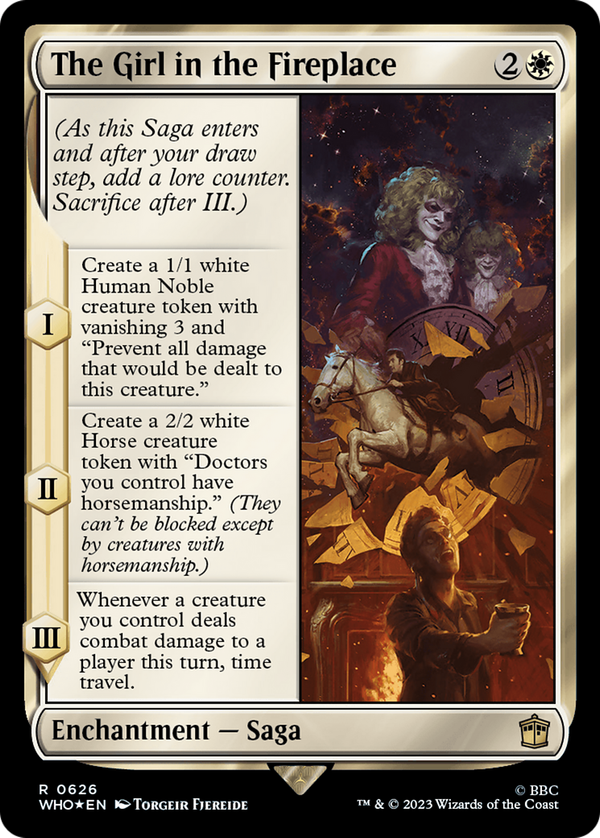
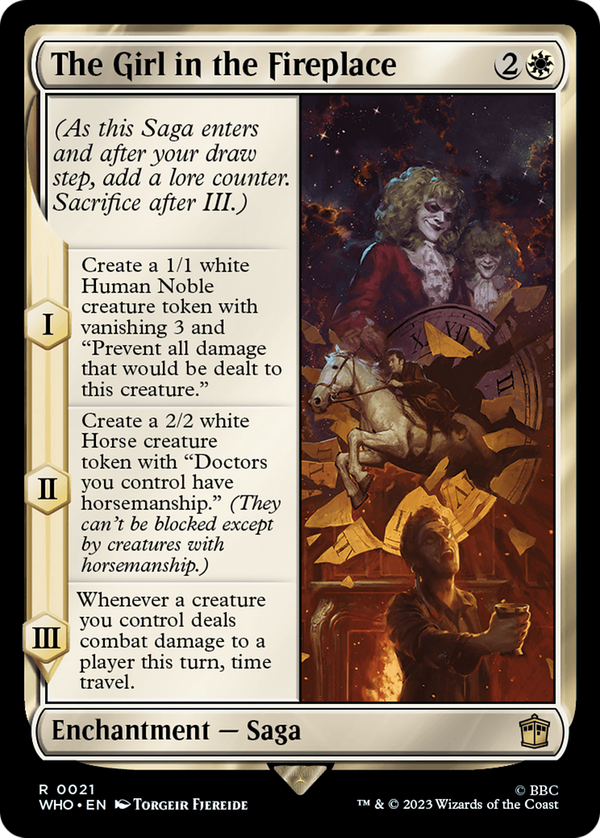
The Girl in the Fireplace


A rare instance of Saga structure telling a story that reads as a narrative rather than a build-up-and-payoff engine, and the mechanical craft underneath is sharper than a licensed tie-in tends to promise. Chapter I spends a token that dies on its own timer, a damage-proof body that vanishes before it can matter much. Chapter II hands your Doctors horsemanship, an evasion keyword that traces back to Portal Three Kingdoms and almost never resurfaces in modern design. Chapter III converts connecting combat damage into time travel, the mechanic that adds or removes time counters on your suspended cards and on permanents you control with time counters. The through-line is deliberate: the horsemanship grant in Chapter II sets up the evasive hit that Chapter III cashes in for the time travel trigger, so the back half functions as a single evasion-into-advancement package rather than three disconnected value events. There is even a quiet internal loop, since time travel can restore a counter to the vanishing token from Chapter I to buy it another turn. The horsemanship reference is the wrinkle most players miss: it only means anything if you actually control cards typed as Doctors, which gates the card's best line behind a specific tribal shell. Divorced from that shell it degrades into a self-sacrificing token maker with a vestigial keyword, which is the honest read away from the deck it was built to reward. As a design, it argues that Saga chapters can escalate causally, each one setting up the next, instead of stacking value and then a finisher.