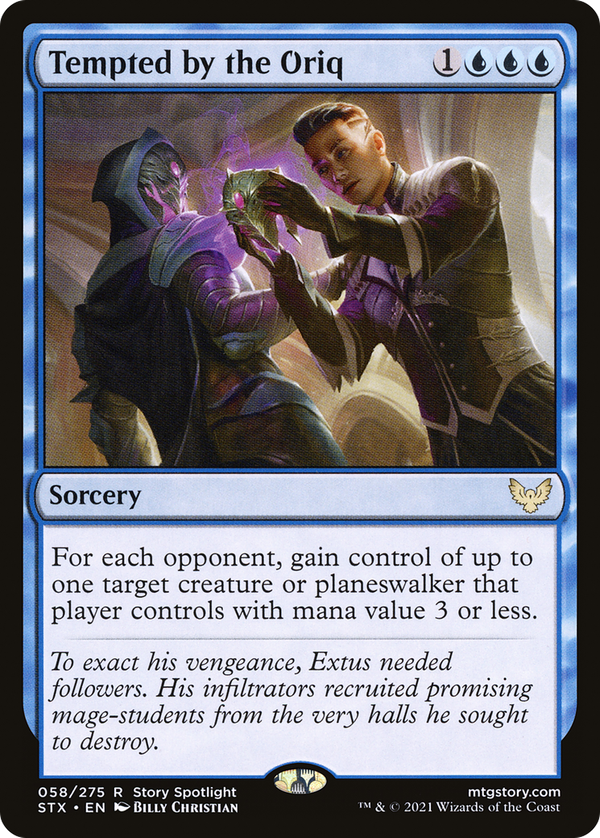
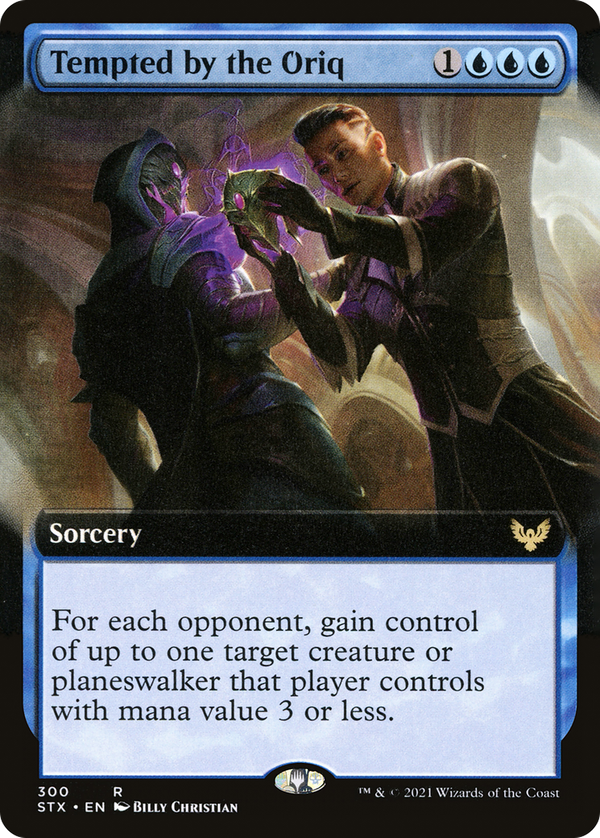
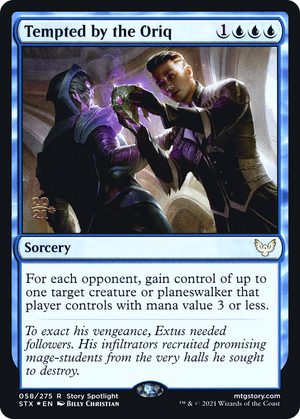
Tempted by the Oriq


Mind control has always paid a premium: the classic template asks five or six mana to steal a single creature, and permanently taking a permanent has historically been priced to hurt. This rescales the theft across the table instead, hitting every opponent at once, and pays for the breadth with a mana-value ceiling of three. That cap does the load-bearing work. It means the card cannot poach the biggest threats, only the small ones: mana dorks, cheap utility creatures, low-cost planeswalkers, the aggressive one- and two-drops that populate the early board. In a duel the effect collapses to a single, restricted steal, which is why it functions as a multiplayer card wearing a two-player card's clothing. Against a full pod, though, the sorcery becomes a board-wide swing that can strip three opponents of their best cheap piece in one cast, converting their early-game advantage into your own. Crucially, the theft is not on loan: as a sorcery with no duration clause, the control change is permanent, and harder to undo than a Control Magic, since there is no Aura to blow up. The triple-blue cost signals the intent plainly: this is a heavily blue-committed effect built for tables where "for each opponent" is a multiplier rather than a rounding error. It rescales an old blue staple's math, trading the single-target flexibility of Control Magic for reach, and drawing a clean line under the top of the curve so that reach never gets out of hand.