Tapping at the Window


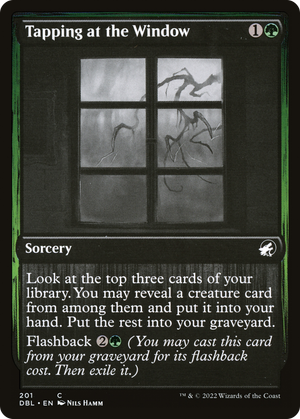
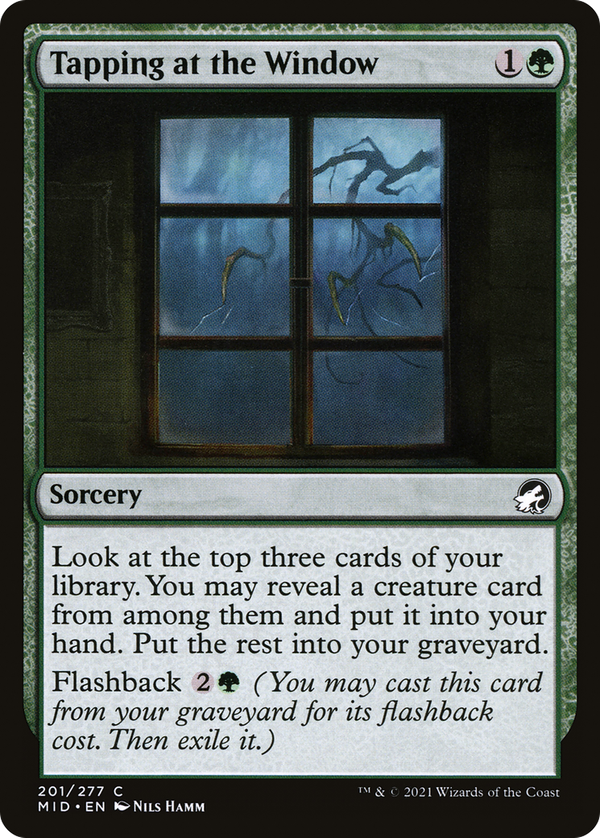
The trade is exact: three cards deep, one creature to hand if there's one worth taking, everything else feeds the yard. That's dig with a cost, and the cost is the two cards you bin plus the risk that all three miss. But those milled cards aren't waste; they're the intended output. Green has spent years anchoring graveyard-matters designs that want bodies in the bin, and this pays into that plan twice: once when you cast it, once when you flash it back. The flashback is the piece that turns a fair filtering spell into an engine. Cast early to find your two-drop, then later cast the same card from the graveyard to refuel and fill the yard again, exiling itself on the way out. Two shots at a creature, six cards seen across a game, and a steady trickle of fuel for whatever the graveyard is doing. The design lives entirely in the gap between "look at three, keep a creature" and "the two you don't keep are the point." For a deck that only wants to find a threat, the binned cards are pure downside. For a deck built to exploit them, that downside inverts into the whole appeal.
Rules text
 (You may cast this card from your graveyard for its flashback cost. Then exile it.)