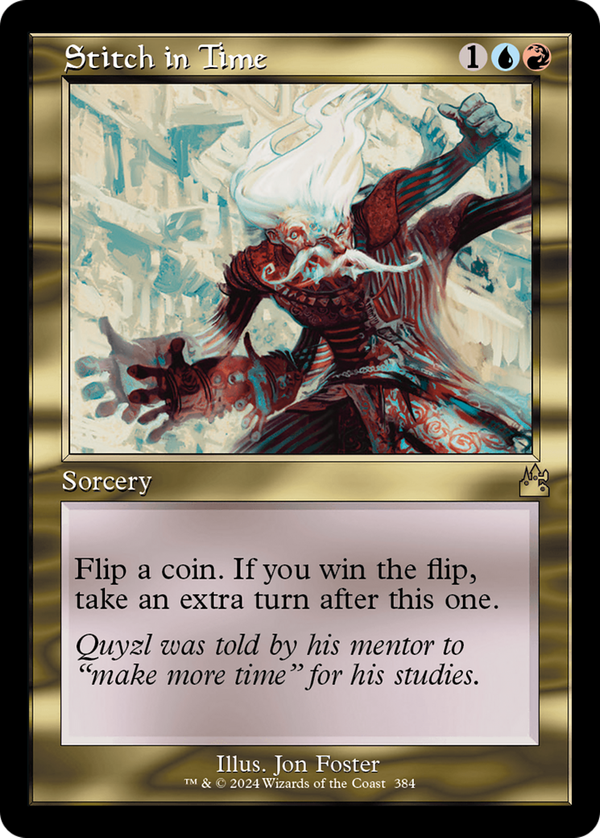
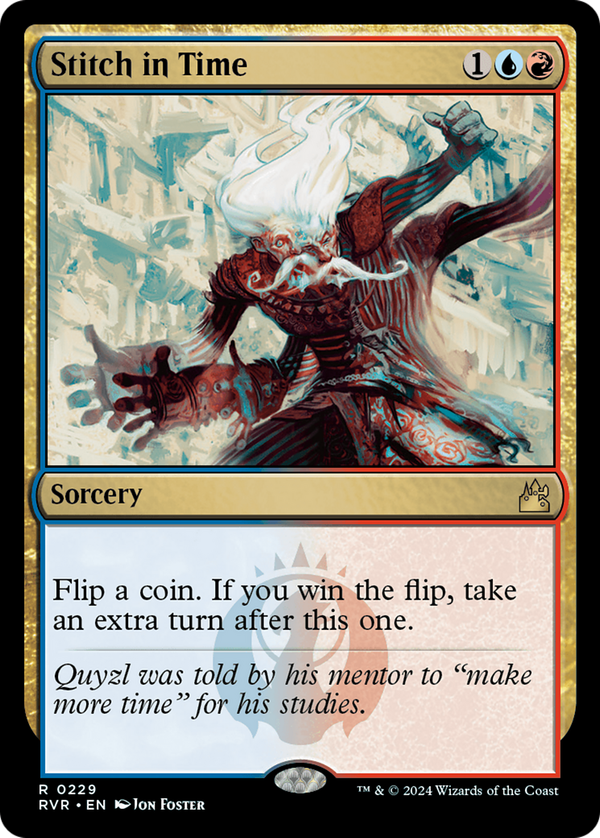
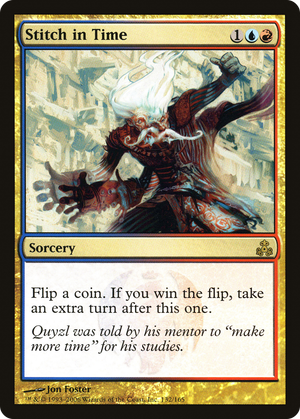
Stitch in Time



The extra-turn effect has always been one of the strongest things blue can do, which is exactly why Wizards keeps strapping a tax to it: prohibitive mana, a discard, exile-from-game on the followup turn. Here the tax is a coin flip. You pay three for an effect that, half the time, does literally nothing, and the other half hands you a full untap, draw, and attack step for a bargain rate no honest Time Walk variant would ever offer. That gamble is the entire identity. It is variance as a design lever, a deliberate choice to price a busted ceiling by making it unreliable rather than expensive, and it sits in a small family of red-blue coin-flip cards built around the same premise: the payoff is real, the math is a coin, and the card lives or dies by whether you can manipulate the odds. Left alone it is a fifty-fifty proposition, which is why anything that lets you reflip, win ties, or weight the result transforms it from a curiosity into an engine. Strip away the coin and you have one of the most coveted effects in the game; the coin is the only reason it costs what it costs. The design honesty of that trade is rare. Most cards hide their downside in a clause you read twice; this one puts the whole risk on a single toss and dares you to build around fixing it.