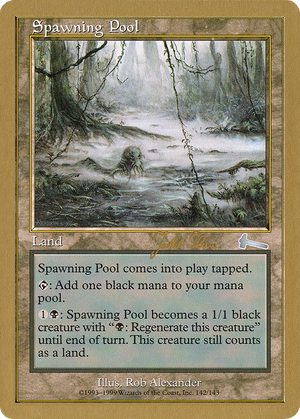
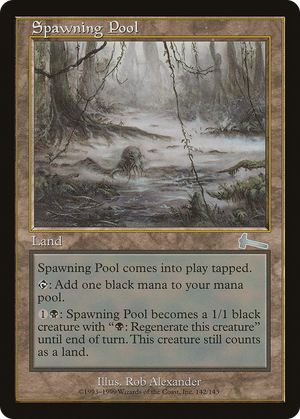
Spawning Pool
The cycle of "manlands" began here, in a five-card run that gave each color a tapland able to turn sideways for a price, and this is the black entry: a land that produces black mana until you have nothing better to spend it on, at which point it becomes a body. The design problem it solves is the dead late-game land. Drawing your fifth land in a flooded grip is a wasted card; drawing this means surplus mana always has somewhere to go, and a regeneration clause makes the Skeleton genuinely hard to kill in combat without exile or a sacrifice effect. The balancing pressure is layered: the land arrives tapped, so animating it is never a tempo play on the turn it shows up; the activation costs more than a 1/1 is worth on its own; and that small body trades into almost nothing, so the payoff is incremental, a recurring drip rather than a finisher. Regeneration is the part that ages best. Against decks built to answer creatures with burn and combat, a land that taps for mana on the turns you need it and blocks indefinitely on the turns you don't is a uniquely awkward target: there is nothing on the battlefield to kill until you choose to make something. The template established here, a land that pays mana to animate into a regenerating creature, is the structural ancestor of every creature-land that followed.
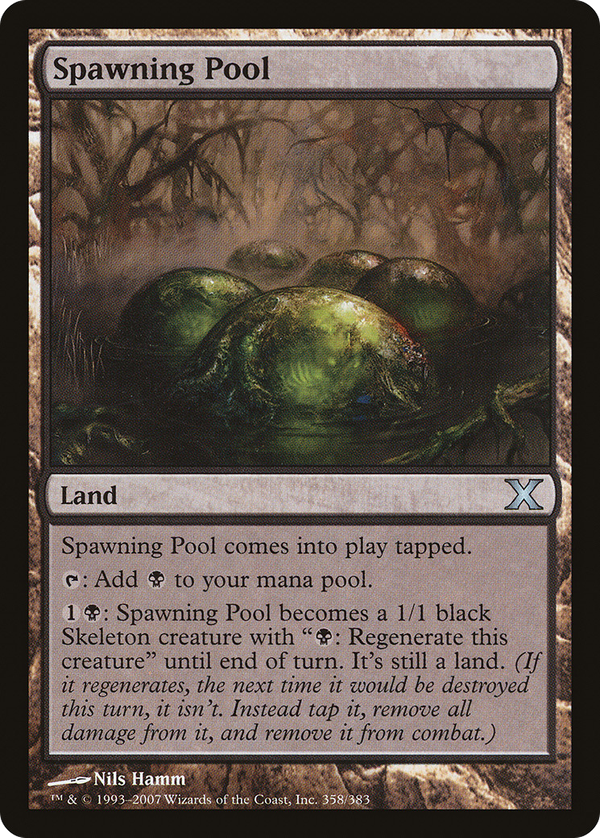
Rules text
 : Add
: Add  .
.
 : This land becomes a 1/1 black Skeleton creature with ": Regenerate this creature" until end of turn. It's still a land. (If it regenerates, the next time it would be destroyed this turn, instead tap it, remove it from combat, and heal all damage on it.)