Soul Strings


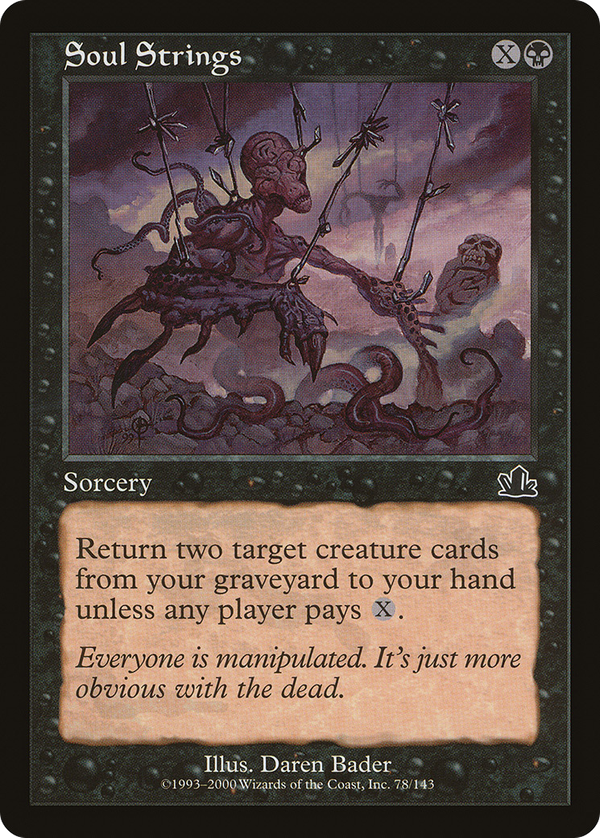
Two creatures from your graveyard back to your hand, with a Prophecy twist: the X you pay is also the toll any player can match to deny you entirely. You set X, as you always do with a variable cost, but here the number is a bid in an open auction rather than a private investment. This is the set's signature tension expressed in black, where Prophecy leaned hard on "unless any player pays" clauses to gate effects through a price the whole table negotiates. Pump X high and you guarantee both cards come home, but you have spent real mana to do it; pump X low and you invite anyone to spend a single mana and keep both creatures buried. The friction is the point. Black's hand-recursion in this era usually returned one creature at a flat cost (Raise Dead, Gravedigger), and stacking two targets onto one card demanded a release valve. The "any player pays" clause is that valve: the spell's true cost scales with how badly the table wants those creatures to stay dead, not with how much you are willing to commit. It works cleanest when the targets are individually unremarkable but collectively threatening, so no single opponent finds the toll worth paying while the doubled value still lands. A negotiation engine dressed as a recursion spell, and a clean artifact of the design philosophy that defined its set.
Rules text
.