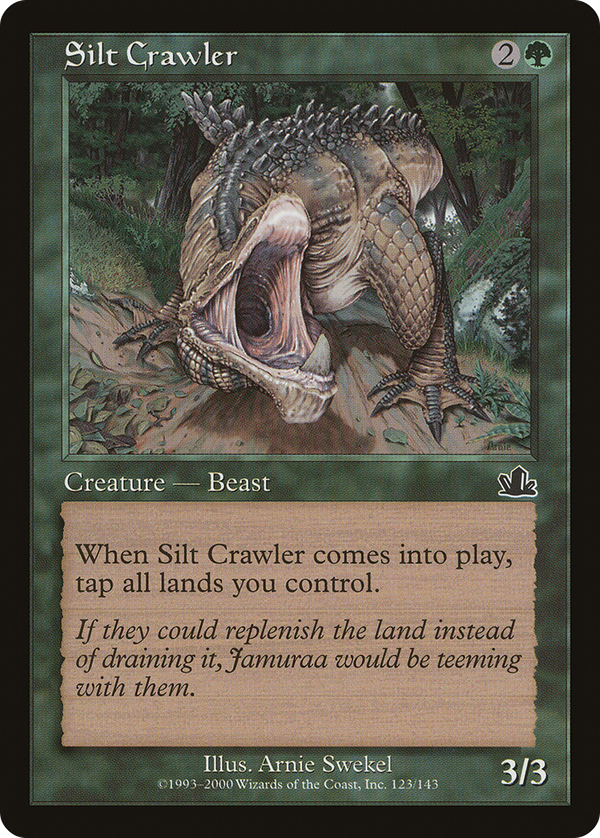
Silt Crawler


The body is a fine green common; the drawback is the whole story. Tapping all your lands the moment it lands means that if you play it as your main deployment you're likely left with no mana up on the crack-back and no surprise. Prophecy's whole design conceit was "rampancy," a set of green cards that pushed payoffs in exchange for these awkward land-tapping costs, and Silt Crawler sits squarely inside that experiment. The mechanic was meant to function as a kind of self-imposed sorcery-speed tax: you get a slightly-better-than-rate creature, but the set asks you to pay for it by surrendering tempo on the turn it arrives. The trouble is that the tax falls in exactly the wrong place. A creature whose only text is a one-time land-tap already wants to come down and hold up nothing, but emptying your mana also empties your ability to respond to a removal spell, a combat trick, or a counter from the opponent's open mana. The constraint that was supposed to balance the rate instead amplifies its single biggest weakness. As a design artifact, it documents a road Wizards tried once and largely abandoned: drawbacks that punish the cast rather than the card's own combat math.