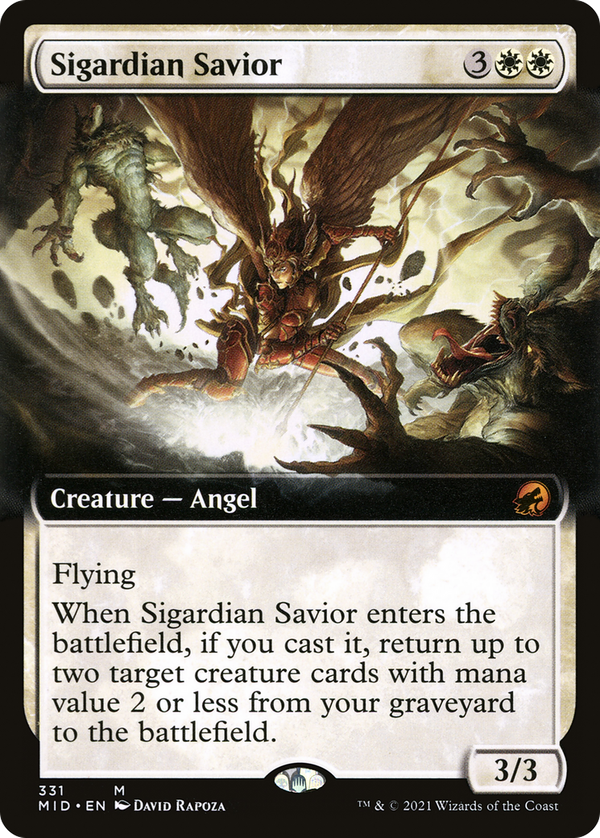
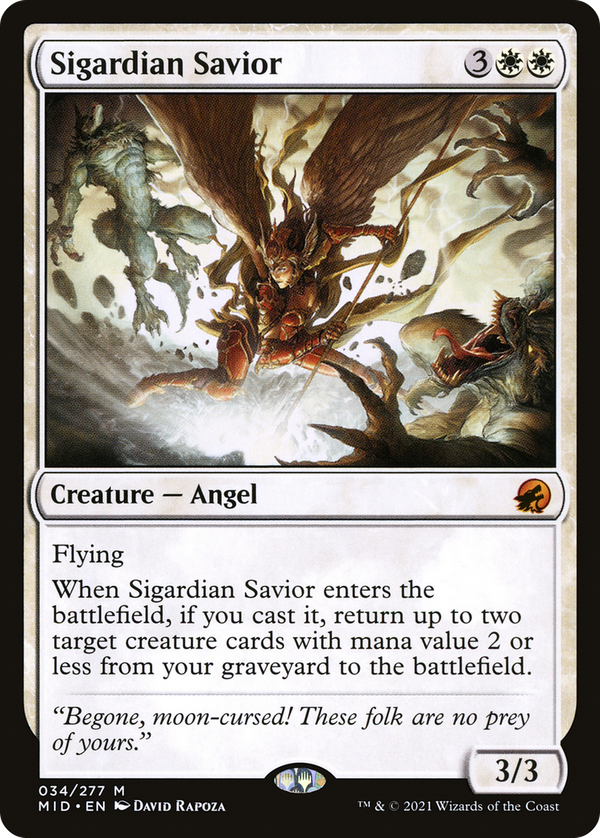
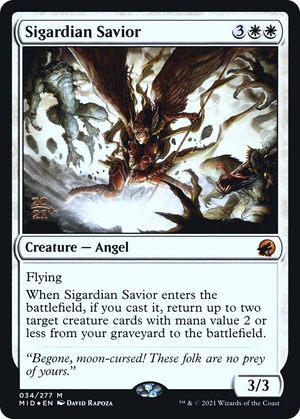
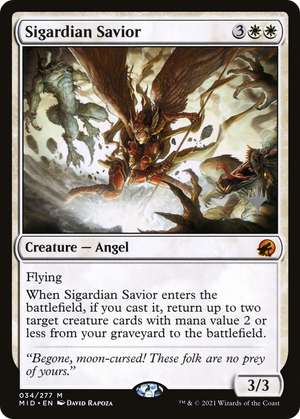
Sigardian Savior


The "if you cast it" clause is where the whole design lives. This is an enters-the-battlefield trigger, not a cast trigger, and the distinction matters: the Angel has to resolve and actually land for anything to come back, so a counterspell shuts the door entirely. But the condition attached to that trigger stacks a second restriction on top of the mana-value ceiling. Because it fires only when you cast the creature, blink loops, flicker engines, and any recursion that would slam the Angel onto the battlefield without paying five mana all whiff on the trigger. What returns is a pair of creatures with mana value 2 or less: mana dorks, sacrifice fodder, small bodies with their own enters-the-battlefield work. That pairing is the idea. The flying body closes a game on its own, and the trigger folds the front half of a creature curve back onto the board in one motion, turning a graveyard full of cheap trades into a second wave. It reads as a resilience card more than an engine: you build around drawing and casting it fresh rather than recurring it, and the two-target cap makes each casting a discrete swing instead of a repeatable loop. White has long looked for ways to rebuild a board of small creatures without the open-ended graveyard toolboxes black and green get for free; this narrows that job to the smallest bodies and asks the deck to have already spent them.