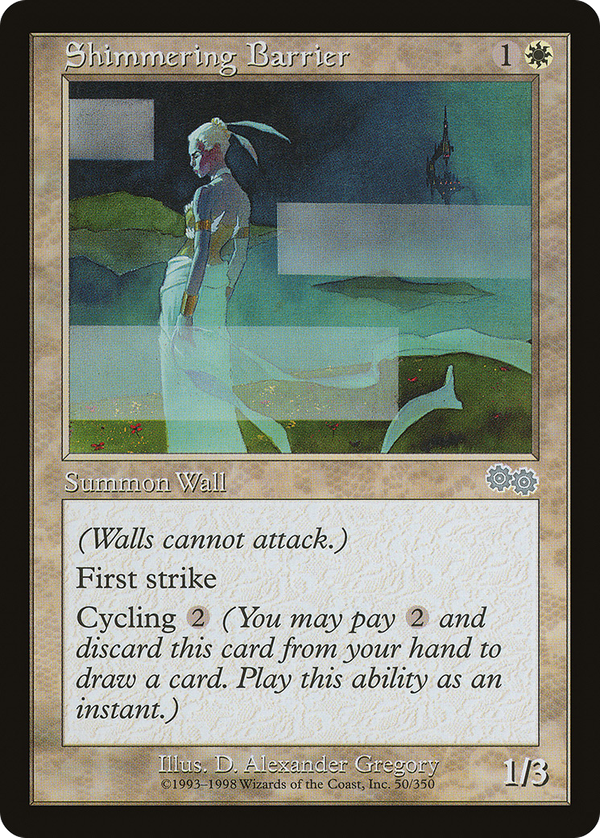
Shimmering Barrier


The Urza's Saga common cycle of cycling walls solved a structural problem older defensive cards never could: dead-card risk. A blocker is only worth a card when the opponent is attacking, and against the wrong draw a wall just sits in hand or rots on the battlefield. Cycling answers that directly by turning an early-game speed bump into a late-game cantrip, so the card is never fully wasted no matter which half of the matchup spectrum you land in. First strike sharpens the defensive math at the edges: the 1/3 body is already a sturdy blocker that profitably eats 1/1s and 2/1s and walls 2/2s, but first strike lets it kill any one-toughness attacker before taking a single point in return, killing the attacker where a plain wall would let it live. Against a 3/3 or a 3/2 the wall still deals its one point and then dies in the regular damage step, so the upside is real but bounded. The design discipline is in the cycling cost, set high enough that you pay a real premium to cash the card in rather than hold it as a blocker, which keeps the choice honest. This was part of a deliberate cycling-everything experiment that ran through the block, and the wall slot was the one where the keyword mattered most: defensive cards are exactly the cards that go dead when the game state turns, and cycling is the cleanest way to give a reactive card an offensive use without rewriting what it does on the battlefield.
Rules text
 (, Discard this card: Draw a card.)