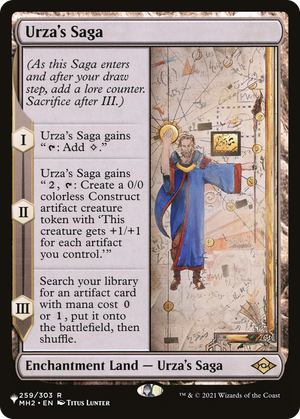
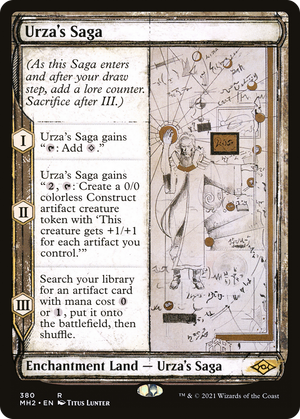
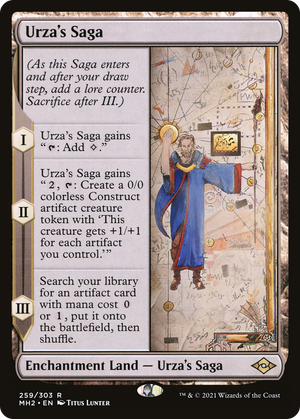
Urza's Saga
Lore counters on a permanent that taps for mana, then makes bodies, then finds an artifact: the provocation is welding a Saga's built-in expiration clause to something you would otherwise want to keep. Sagas were designed to expire, and turning that self-destruct into a land drop is the tension that pays for everything else. You spend a land to keep, riding a compressed value curve that ends by sacrificing itself to tutor a zero- or one-cost artifact straight onto the battlefield. That trade only breaks even where the fetched artifacts already carry games by themselves, so the whole engine leans on the reach of its final chapter. The middle chapter keeps the wait from being dead time: Constructs that scale with your artifact count give you a growing clock while the counters accrue. What the design actually did was redraw the boundary of what a land is permitted to do. It made every zero- or one-cost artifact suddenly tutorable at almost no deckbuilding cost, dragging a whole class of zero- and one-mana artifacts that had never justified a tutor slot into serious evaluation. The same clock that limits the card is what delivers its payoff: the drawback and the reward are one clause. Few untapped mana sources have ever carried this much strategic weight while remaining, in the end, a resource you consume rather than hold.
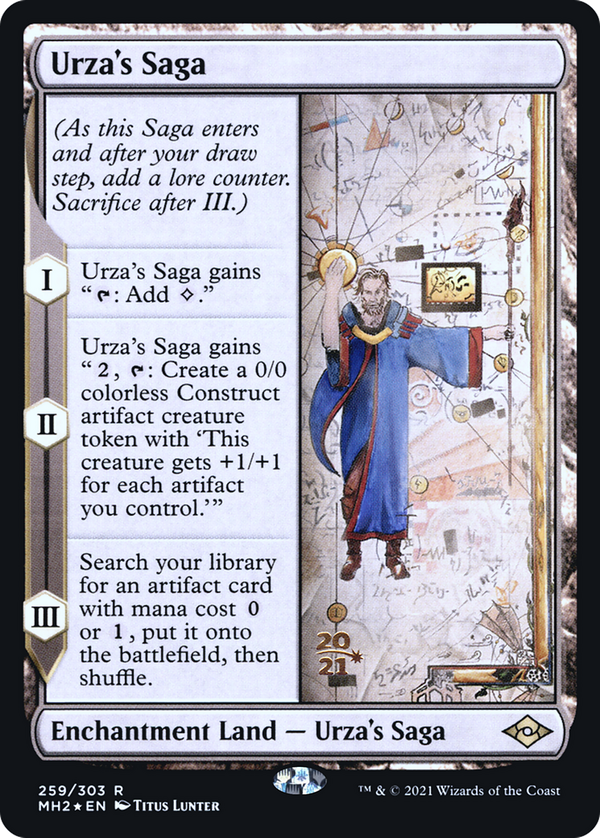
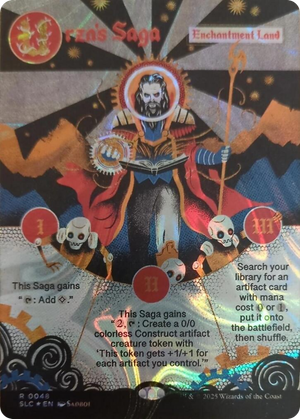
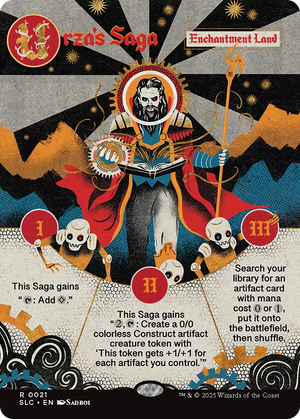
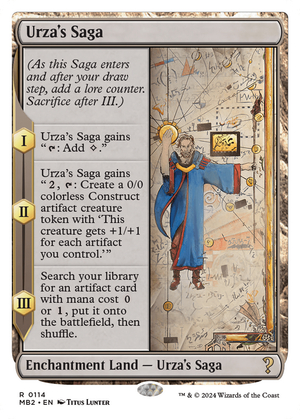
Rules text
 : Add
: Add  ."
II — This Saga gains "
."
II — This Saga gains " , : Create a 0/0 colorless Construct artifact creature token with 'This token gets +1/+1 for each artifact you control.'"
III — Search your library for an artifact card with mana cost
, : Create a 0/0 colorless Construct artifact creature token with 'This token gets +1/+1 for each artifact you control.'"
III — Search your library for an artifact card with mana cost  or
or  , put it onto the battlefield, then shuffle.