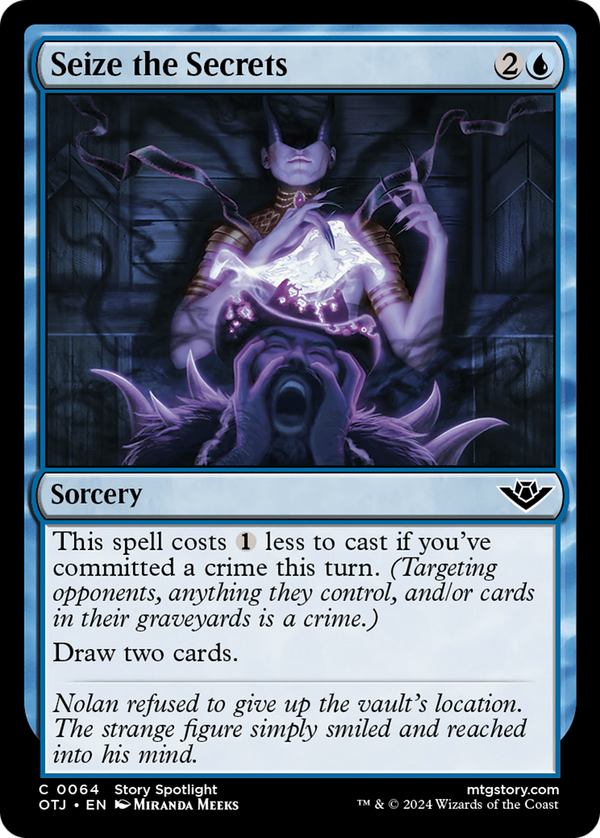
Seize the Secrets


Divination set the baseline for two-cards-for-three in blue, and every faster refill since has had to pay for its discount somehow: a life payment, a card pitched to the graveyard, a condition that only comes online late. This one hangs its discount on a mechanic that recasts ordinary blue aggression as a trigger. Committing a crime is not a hoop; it is a description of what an interactive deck already does with its turn, since pointing a removal spell at a creature, countering a spell, or exiling a card from an opponent's graveyard all qualify. Do any of those earlier in the same turn and this drops to two cards for two mana, a rate blue has rarely reached without a real drawback attached. The design sleight is that the crime clause costs nothing when your deck was already going to interact: it reads as a restriction but functions as a reward for playing proactively with your removal. The binding constraint is the wording, not the sorcery speed itself. Because the crime must be committed this turn, the discount lives entirely inside a single turn's sequencing: you have to spend the removal spell or counterspell on your own turn, before you cast this, to bank the price cut. Interaction held up on an opponent's turn does nothing for the cost once you untap; the clock resets, and you are back to paying full freight unless you commit a fresh crime.
Rules text
 less to cast if you've committed a crime this turn. (Targeting opponents, anything they control, and/or cards in their graveyards is a crime.)
Draw two cards.
less to cast if you've committed a crime this turn. (Targeting opponents, anything they control, and/or cards in their graveyards is a crime.)
Draw two cards.