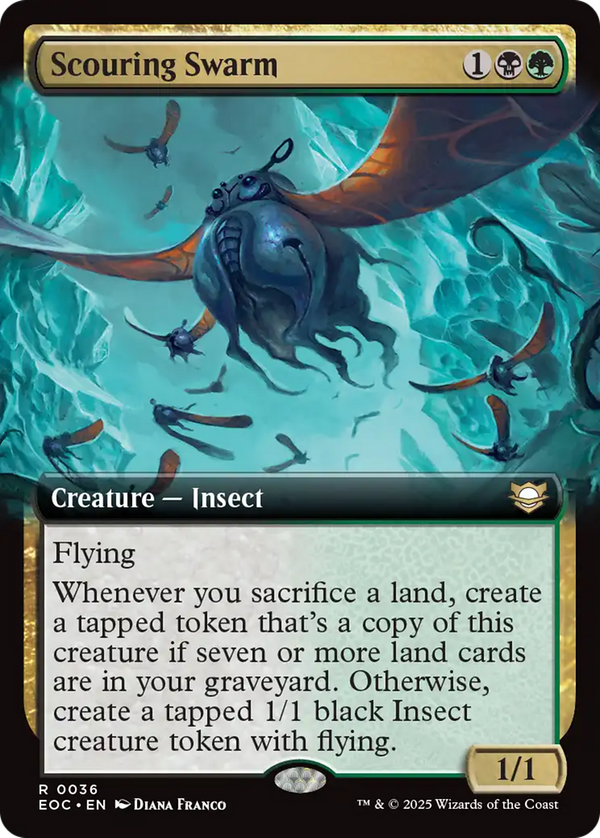
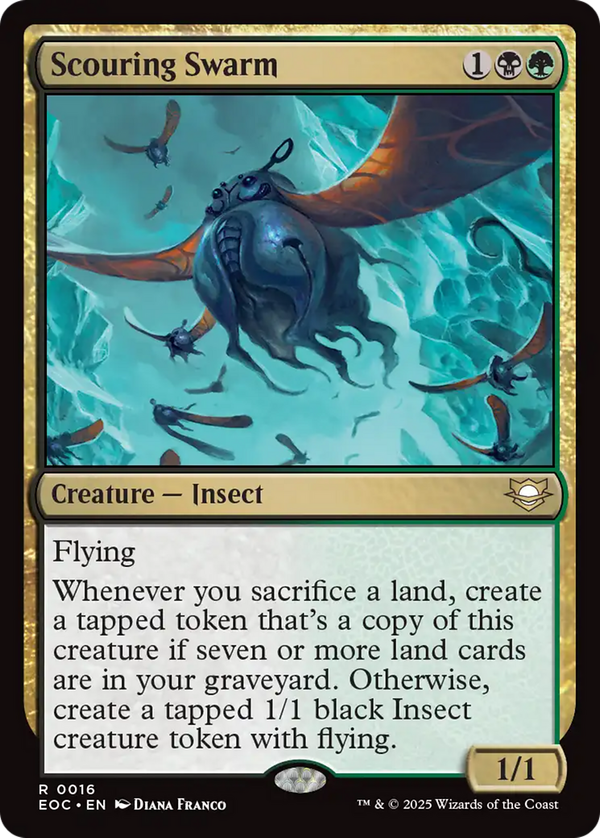
Scouring Swarm



Land sacrifice usually reads as a cost, a resource you spend to dig or ramp. Here it reads as a payoff loop, and the graveyard count is the switch that decides how big the payoff gets. Every land you feed to a sacrifice outlet mints another flier, so the card wants the kind of deck already built to eat its own lands: fetch-and-crack fixing, Zuran Orb effects, dredge-adjacent self-mill, anything that treats the graveyard as a second hand. Below seven lands in the yard, each sacrifice buys a modest 1/1 flying body, a fine grinding rate on its own. Cross that seventh land and the outputs stop being chaff: each token becomes a copy of the whole engine, so the next sacrifice makes a copy, and that copy makes copies, and a single sacrifice outlet with enough fodder turns into a flying army that scales with how greedy your manabase has been. The seven-land clause is the discipline that keeps the loop from being free value from turn one; it demands you actually commit to the graveyard as a build-around before the card pays out its ceiling. What makes the design sit right is that the two halves point the same direction: the deck that wants cheap fliers off land sacrifice is the same deck that fills its graveyard doing it, so the threshold arrives naturally rather than as a tax you have to work around.