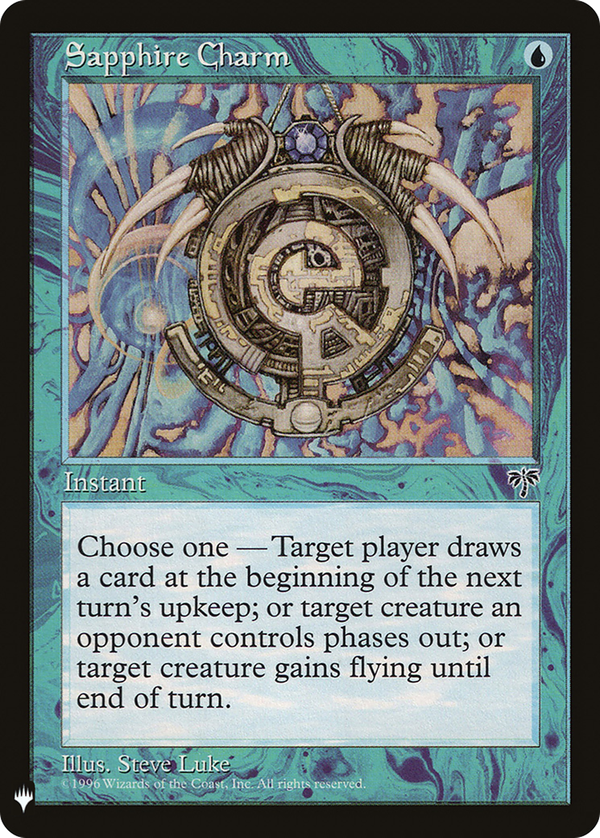
Sapphire Charm

Three small blue effects stapled to a single point of mana, none of them worth a card by itself, which is the entire pitch: the card is never dead, never spectacular, and always has a line that fits the board in front of you. The draw mode is a cantrip on a delay, deferred to the next upkeep so that a one-cost instant doesn't get to replace itself for free; the flying mode reads more as a finisher enabler than a blocking trick; and the third line is where the card earns its place in the set's design story. A creature an opponent controls phases out, vanishes through the attack step, and returns before its controller's next untap, which makes this a Falter-style combat answer wearing the costume of removal rather than the real thing. That phasing line is the historically telling one: the mechanic that defined this expansion usually showed up as a permanent's drawback, and here it gets repurposed as a clean tempo tool you can fire at instant speed. The modal frame is doing all the work. Folding three color-appropriate utility effects together produces something that flexes to the situation, which is exactly the brief the charm cycle was built to demonstrate. It also captures mid-90s blue's idea of efficiency: instant-speed card advantage and cheap interaction had not yet acquired their modern price tags, so a flexible one-cost cantrip-plus-trick read as a fair deal.