Rhystic Cave
Prophecy's Rhystic cards were built around a single tension: an effect that resolves at full value unless an opponent will spend the smallest possible tax to deny it. Here the application is mana production, and the design quietly teaches resource economy. A land that taps for a color is unremarkable; a land that taps for a color and forces every opponent to choose between letting it resolve or paying one mana to cancel it turns each tap into a tiny auction. In a one-on-one game the math rarely favors the land's controller, since a single generic payment kills the effect and the opponent usually has a spare mana lying around. The logic only opens up as the table grows: the tax gets paid once, by one player, but the mana denied is yours, so a crowded board makes the symmetry start to bend. The "activate only as an instant" clause is the genuinely load-bearing piece, and it works against you rather than for you: because the timing restriction bars activating it mid-cast, you cannot tap the land to pay for a spell as you cast it. You have to activate it on its own, let it resolve through the auction, and float whatever survives. Rhystic was never a keyword, just a naming convention for the cycle, but the underlying idea (asymmetric taxes that scale with the number of opponents) is the same engine that later powered Rhystic Study, which traded mana for cards and found its true home where the tax gets paid the most.
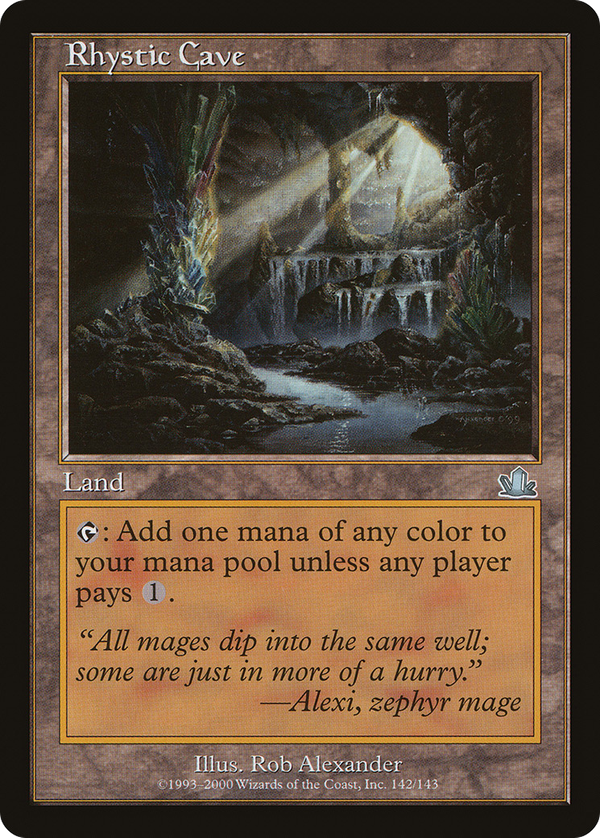
Rules text
 : Choose a color. Add one mana of that color unless any player pays
  . Activate only as an instant.