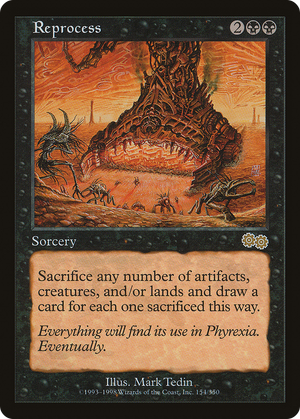
Reprocess


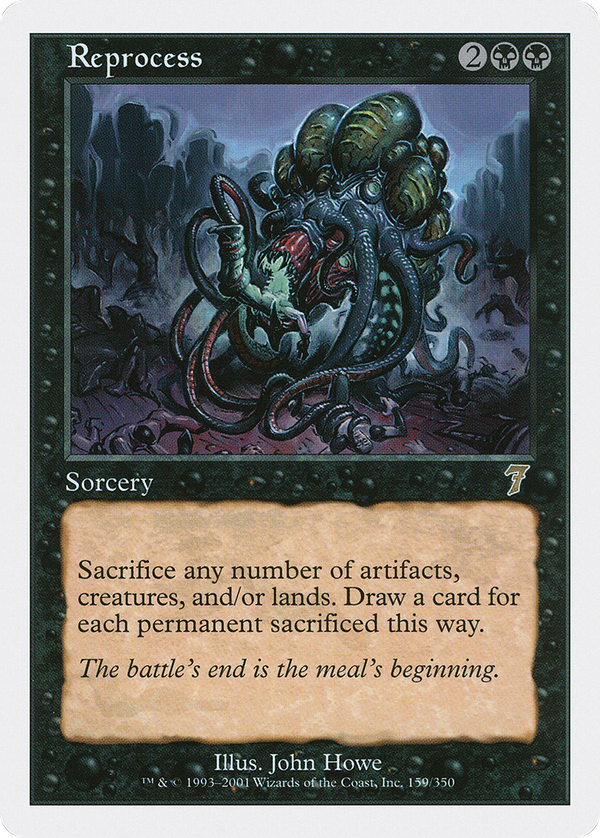
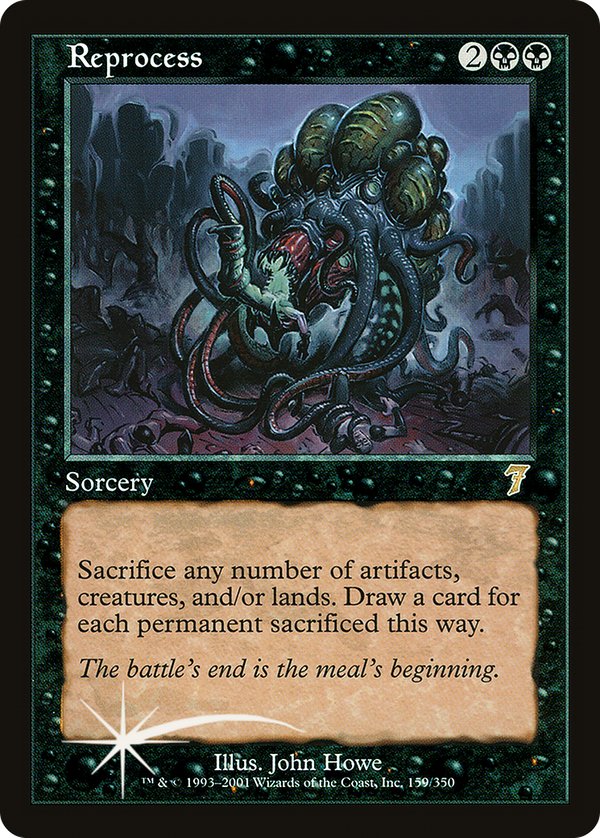
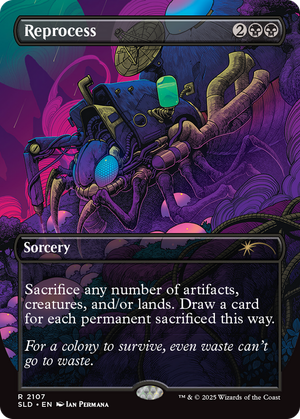
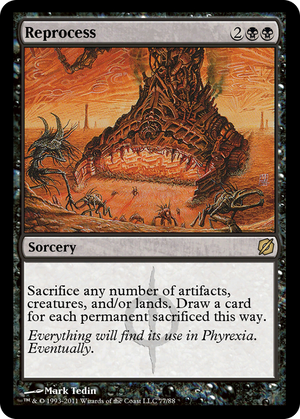
The conversion rate is the whole pitch: one permanent for one card, paid out in bulk. That math reads worse than it is because it ignores what the permanents were already doing. The things being sacrificed have, in most cases, already spent their value: a creature that has stopped attacking into a stalled board, an artifact whose enters-the-battlefield trigger fired long ago, a land that has tapped for its last useful mana. What this converts into card advantage is everything that has quit earning its place on the board. It belongs to a black design tradition that turns standing assets into raw cards, but the brute, unconditional breadth here (any number, any combination of three permanent types) makes it a closer rather than an engine: empty the board, refill the hand, then play from a hand your opponent cannot read. The sorcery speed is what pays for that generosity. There is no instant-speed blowout, no sacrificing in response to removal to deny a kill; you commit on your own turn, having decided in advance which permanents have outlived their usefulness. You give up converting dying creatures at the last moment, the way an instant-speed sacrifice outlet would, and in exchange the spell is permitted to be this open-ended. That bargain, surrendering timing flexibility for unconditional breadth, is the axis the whole card turns on.