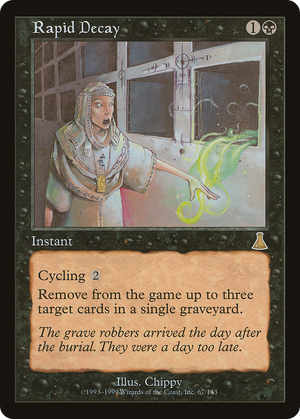
Rapid Decay


Graveyard hate has always carried a structural tax: a card that does nothing against an opponent without a graveyard plan is a card you flinch from maindecking, which is why so much of this effect historically lived in sideboards. Cycling rewrites that math. When the matchup never shows, you pay two and discard for a fresh card, so the slot stops being a liability and becomes a hedge with a guaranteed floor. The hate itself is surgical rather than total: exiling up to three cards from a single graveyard means you pick off specific threats (a flashback spell, a reanimation target, a key fuel piece) instead of resetting the whole yard the way a full sweep does. Targeting only one graveyard at a time, and only a handful of cards, is what holds the rate in check; you answer the cards that matter at instant speed, in response to the trigger that needs them, but you cannot erase an entire graveyard strategy in one motion. That pairing of a focused effect with a built-in escape hatch is the through-line: a reactive answer engineered to refuse the dead-draw, which is exactly the problem graveyard interaction has spent decades trying to design around. It is a clean early response to a question that keeps getting re-asked, and the cycling clause is why it solves both halves at once.
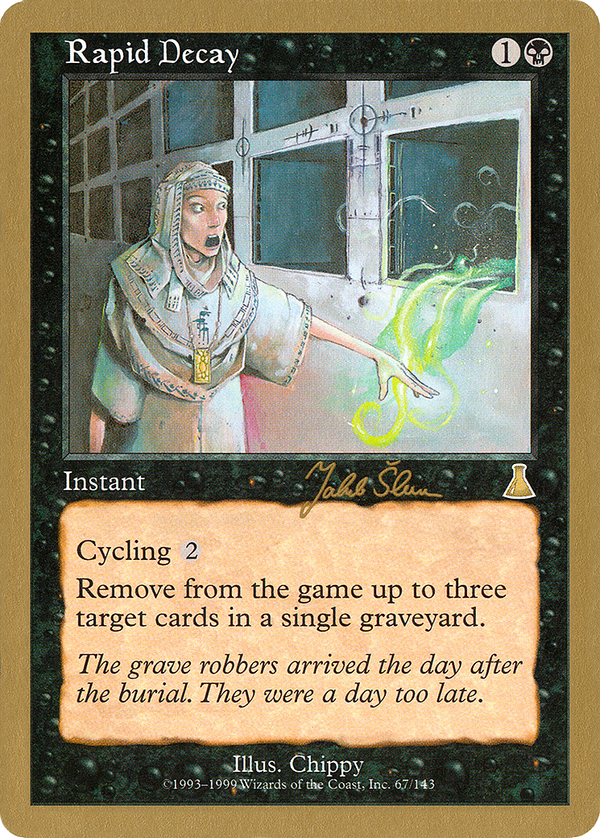
Rules text
 (, Discard this card: Draw a card.)