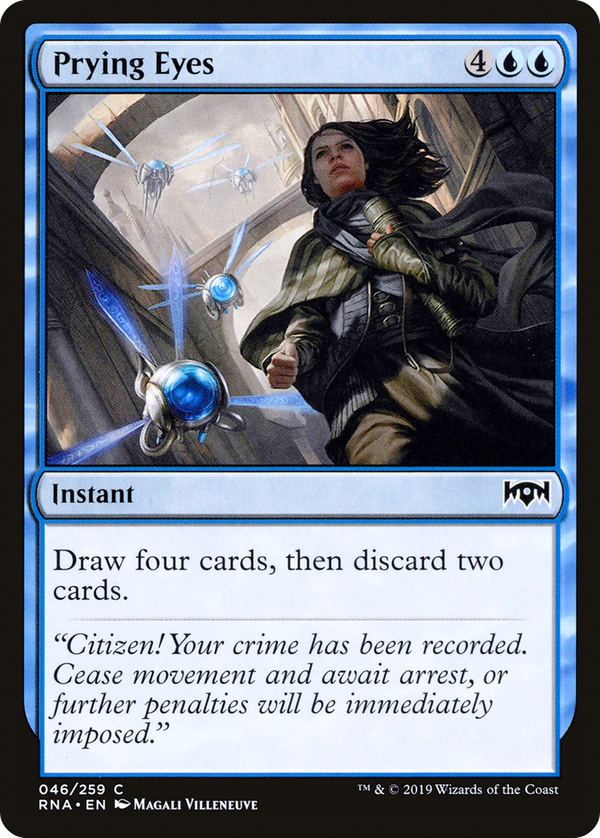
Prying Eyes


Draw four, discard two: a net gain of a single card for six mana, which is a losing trade on rate against any generation of blue draw you care to name. That arithmetic is exactly the point, because this was never built as an advantage engine. The discard is the discipline. What looks like an overpriced Divination becomes a deep, selective dig: burrow four cards down, keep the two lands or answers you actually need, and pitch whatever the churn coughed up. Instant speed is the feature that justifies the price. It lets the caster hold up a counterspell or removal window and only spend the mana on filtering if that window goes unused, so the spell competes for a turn rather than demanding one; the fullest information comes when the opponent has already committed. The lineage is the blue draw-then-discard effect that has been priced up and down the curve since the game's early years, and this one sits at the expensive, high-yield end, buying the depth of the dig and the flexibility of when to cast it rather than buying efficiency. Where the two discards matter beyond the loot, in shells that want cards in the graveyard, the arithmetic flips again: the pitched cards stop being a tax and become setup. Judged as pure card advantage it is a bad deal; judged as a large, flexible, instant-speed dig, it does precisely the job it was cut for.