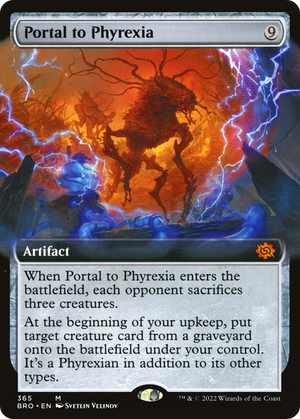
Portal to Phyrexia

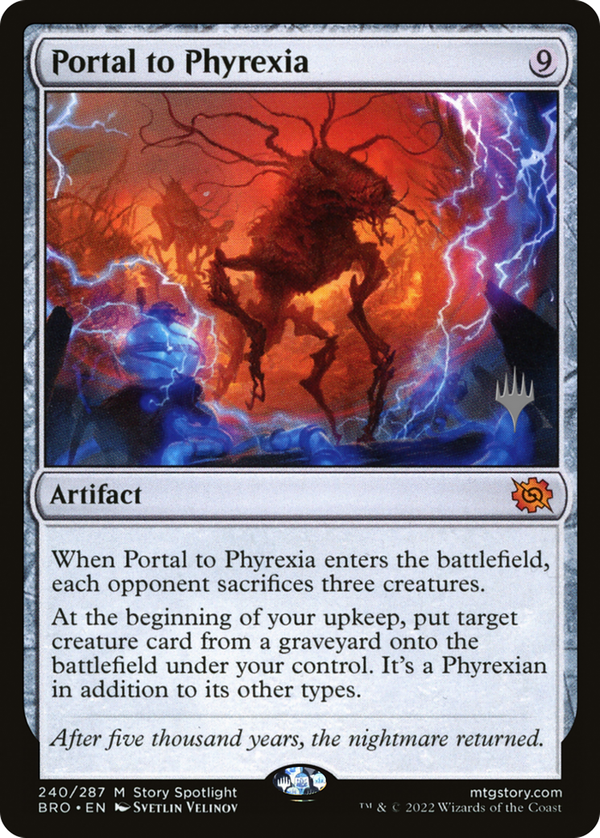
Nine generic mana is the price of admission, and the card is engineered so that reaching it feels like tripping a wire rather than casting a spell. The entry trigger does not remove your opponent's best creature; it forces the sacrifice of three, a distinction that matters enormously against decks built to protect a single threat. You are not answering the board, you are gutting it, and because the sacrifice is opponent-chosen, the play pattern rewards you for a battlefield already thinned by removal, where three losses cannot be spread across chaff. Then the artifact settles in as a recurring engine: every one of your upkeeps, a creature card leaves any graveyard (yours or theirs) and returns under your control, now stapled with the Phyrexian type. The compleation flavor is not cosmetic; it turns the card into a slow-motion assimilation of whatever the game has already killed, and it does not care whose graveyard fed it. What makes this a boardstate rather than a spell is the total absence of an off-ramp for the opponent: there is no life-payment clause, no tap requirement, and short of removing the artifact itself, only graveyard interaction can disrupt the recursion. It is a colorless payoff for the biggest mana engines in the game, built to be the thing you win with once the ramp has done its work, and it asks nothing of your deck except the willingness to get to nine.