Phyrexian Scriptures


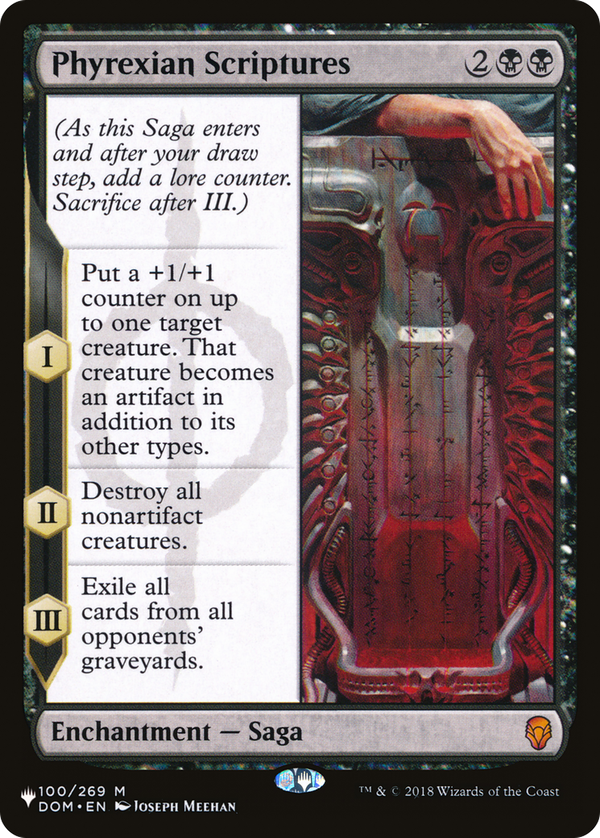
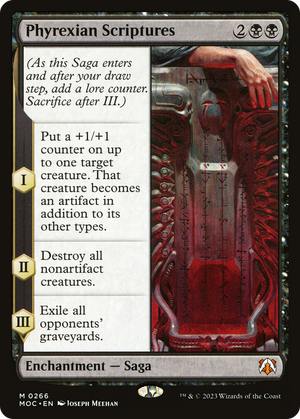
Sequencing is the whole trick, and once you see it the card stops looking like a worse Damnation. Chapter II reads "destroy all nonartifact creatures," which does nothing for the caster until you notice that Chapter I, resolving a full turn earlier, hands one of your creatures a +1/+1 counter and the artifact type. Line those two chapters up and the wipe fires one-sided: your survivor walks out of the sweep with a counter as interest while the opponent's board is scoured. The tax is the lore-counter clock. The board wipe is telegraphed a turn in advance, so the opponent gets one window to hold back or overcommit and gamble on the math, and the exemption has to be prepared before the sweep, not found in response to it. Chapter III then exiles every opposing graveyard, an idle afterthought against a creature-flooding aggro deck but a real answer to the reanimator and recursion strategies a slow black control shell fears most. This kind of design showed how much removal gained from the sequential frame that arrived with these three-chapter enchantments: a sweeper unfolds as a plan, not a single sorcery, and the delay that would otherwise be pure downside becomes the setup that makes the sweep asymmetrical. It rewards planning ahead with graveyard hate stapled to the back end, a compact case for why the template suited destruction as neatly as it suited narrative.