Parker Luck


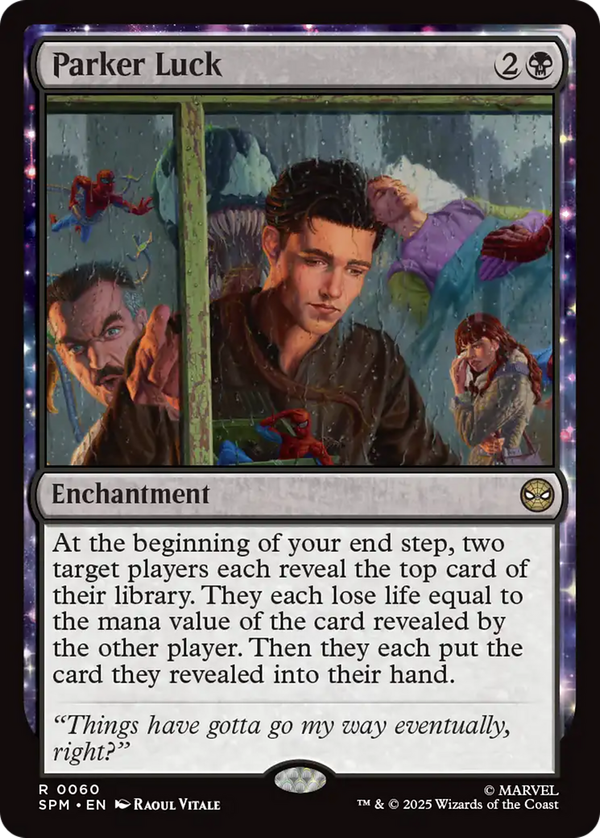
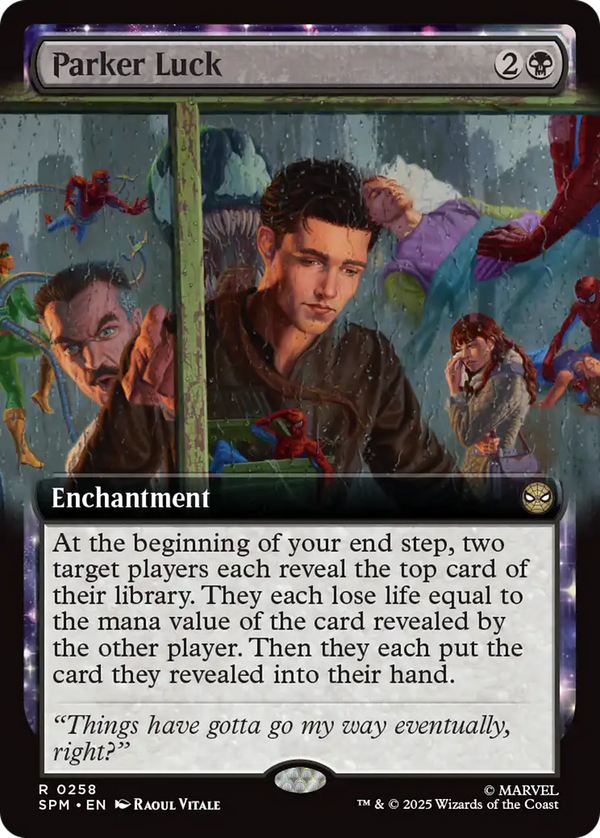
The joke is the geometry. Each of the two targeted players loses life not for their own reveal but for the other player's card, turning a symmetric-looking effect into a mutual game of blind fortune where neither participant controls their own life total. As the enchantment's controller you can name yourself as one of the two targets, which means volunteering to swallow a stranger from the top of an opponent's deck: the payoff is that both revealed cards go straight into their owners' hands afterward, so nobody is card-disadvantaged, only life-taxed. That hand refund is what keeps the design from being pure symmetrical life loss; it reframes the effect as a repeating end-step toll that trades life for a slow, guaranteed card each turn on both sides of the exchange. Note the wording matters for the value engine: the card is put into hand, not drawn, so it dodges anything that keys off a draw step. The lineage here is chaos-enchantment humor rather than efficient removal: the loss scales with the revealed card's mana value, so it swings from harmless (two lands flipped) to genuinely punishing (two expensive spells) with no way for either player to plan around the reveal. Whether the toll lands on you or your opponents is the entire point, a mechanized rendering of good-and-bad-luck-in-the-same-breath that leans hard into fortune cutting both ways.