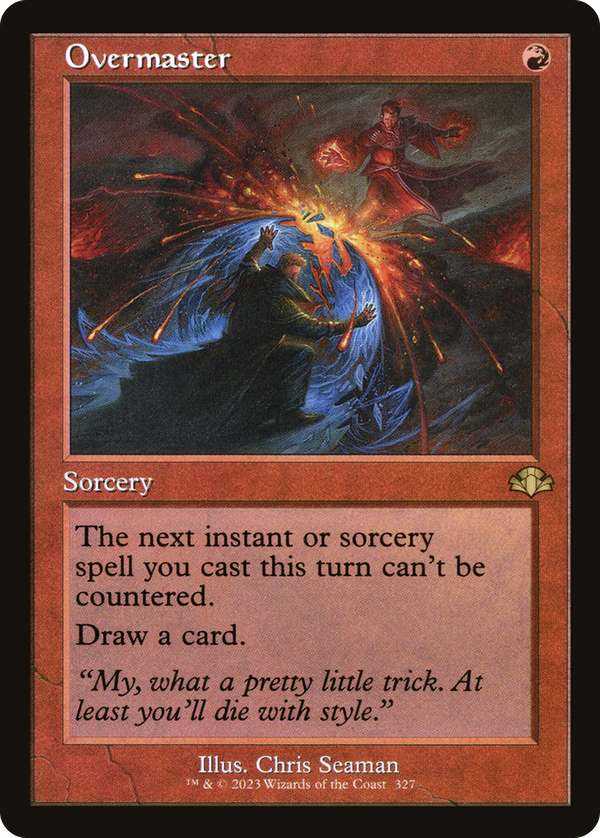
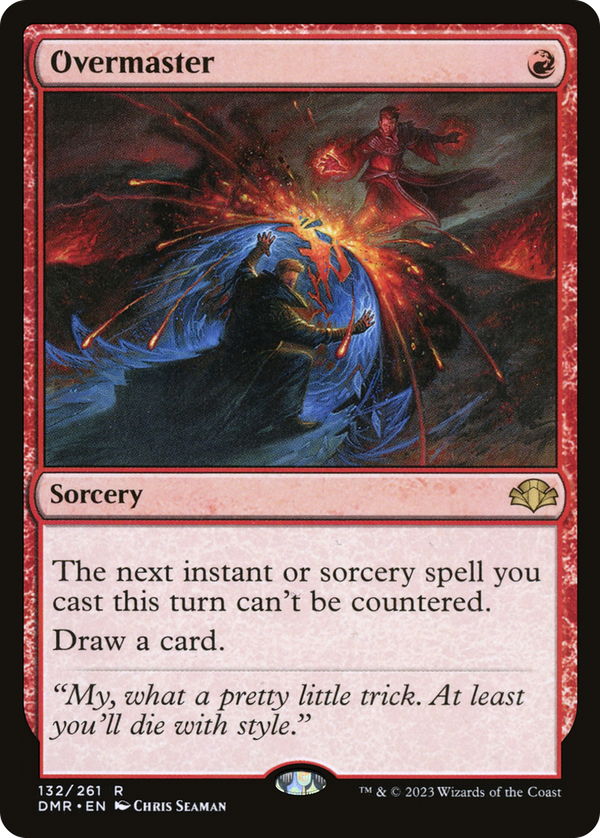
Overmaster

Anti-counter insurance that pays for itself. Most cards built to fight permission tax you for the protection: you either pay extra mana up front, hold up a Pact, or split your turn between the guard and the payoff. Here the cost is a single red mana, and the spell cantrips, so the only real expense is a slot in the chain and a beat of your turn. The design problem it solves is the dead-card trap that haunts every counter-the-counter effect: a spell whose only job is to guard against permission is worthless against a deck that isn't holding any. By drawing a card, it sidesteps that entirely. Worst case, it's a one-mana cantrip that has at least cycled itself; best case, it slams the door on a Counterspell and lets your real payoff resolve clean. The catch lives in the timing: the protection covers only the next instant or sorcery you cast this turn, so it asks you to sequence around it rather than hold it as open-ended insurance. You cast Overmaster already knowing what you intend to push through, then resolve that spell into a window a control opponent can no longer touch. It's a small, almost surgical piece of design from an era when blue's grip on the stack was tight enough that combo and burn decks needed a cheap, low-opportunity-cost way to punch through, without committing a card that would rot in hand against everyone else.