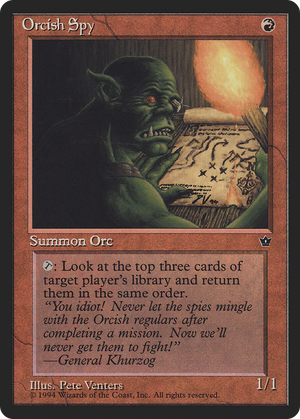
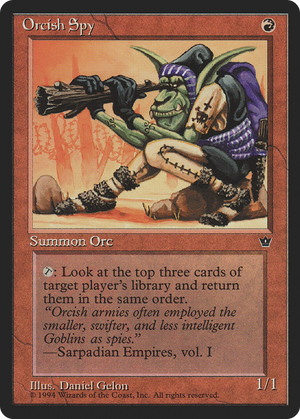
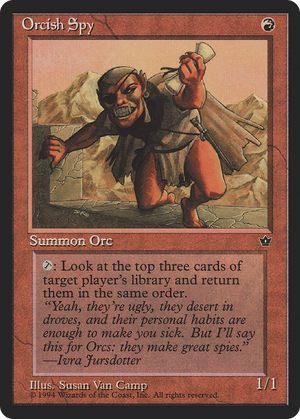
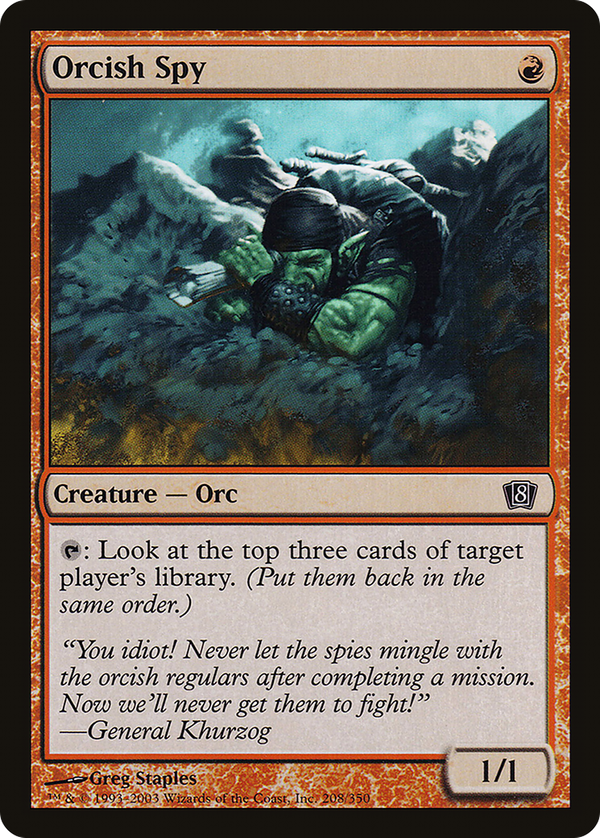
Orcish Spy

A perfect specimen of mid-90s design before information was understood to have a price. The whole card is a tap ability that lets you peek at the top three cards of someone's library, with no rider, no replacement, no follow-up: pure knowledge, sold for one mana and a 1/1 body. The problem is that knowing your opponent's next three draws does nothing on its own. There is no surveil to rearrange them, no mill attached, no way to act on the read beyond playing around what you saw, which is the kind of marginal edge a high-level player extracts and everyone else ignores. It reads like a card built around a metagame of bluffing and hidden information that the game's actual decision points never rewarded enough to justify a slot. What it does illustrate is how early Magic priced abilities by intuition rather than by board impact: peeking at your opponent's deck felt powerful in the abstract, so it cost a card and a creature, even though the effect changes no life total and removes no permanent. Later designers learned to bolt information onto something material (a body that scries, a cantrip that surveils) precisely because raw, actionless information had proven to be the cheapest thing in the game to give away.
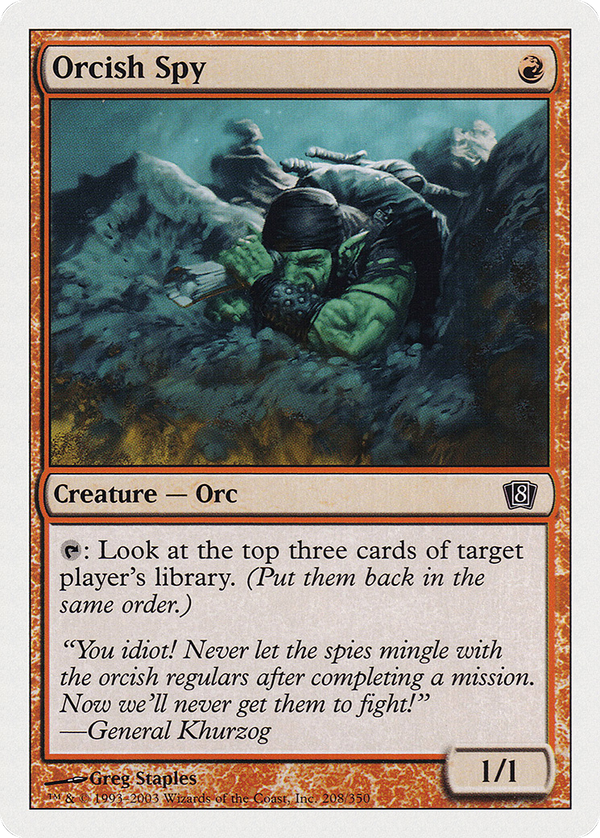
Rules text
 : Look at the top three cards of target player's library.