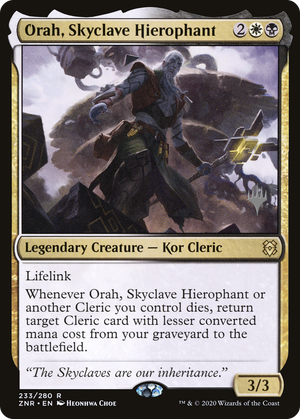
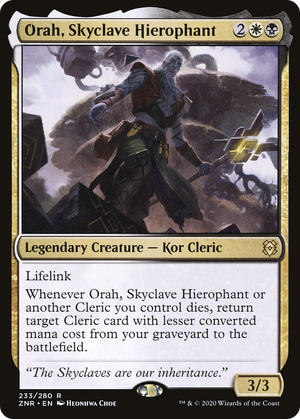
Orah, Skyclave Hierophant



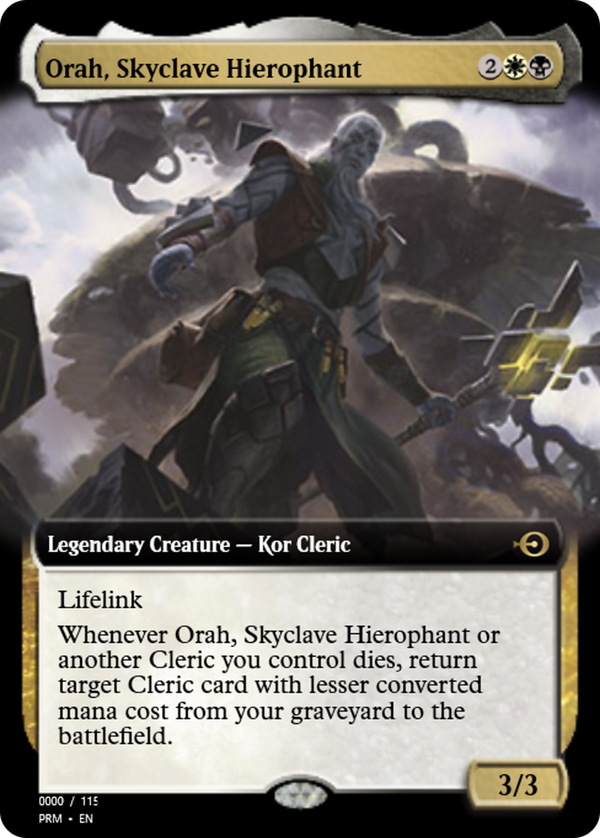
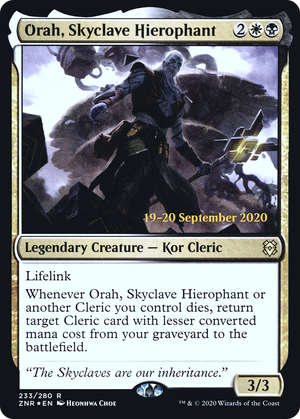
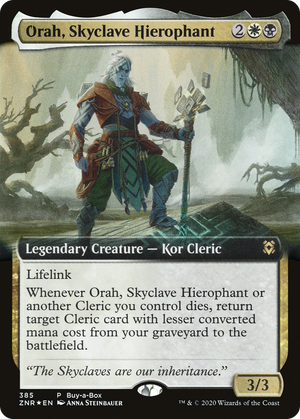
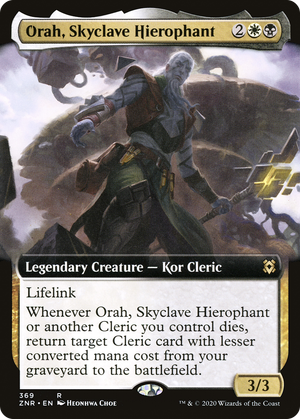
For most of the game's history, "Cleric" was a costume: a flavor tag stapled to lifegain and disruption bodies, priests of Serra and their kin, with almost no mechanical throughline binding them. This gives the tribe a proprietary payoff that reads its own creatures dying as fuel, and the design lives entirely in one clause. The recursion trigger steps down the curve: every death returns something strictly cheaper, so the loops descend rather than sustain themselves. You cannot pingpong two same-cost Clerics forever; the chain always walks toward the bottom of the graveyard. That single constraint does most of the balancing work, and it changes what deckbuilding asks of you: stock a proper cost distribution rather than a single loop piece. Pair it with a free sacrifice outlet and it reanimates targets into value one card at a time, but the ceiling stays capped by that lesser-mana-value clause in a way a pure sacrifice engine never is. The lifelink on a 3/3 is the quiet half of the package, letting the incidental drain from a grinding board keep you afloat while the recursion does its slow accumulation. It is the closest the Cleric type has come to a genuine mechanical identity rather than a wardrobe: a payoff that finally reads the tribe's own bodies as a resource, with a cost ladder that keeps the reading honest.