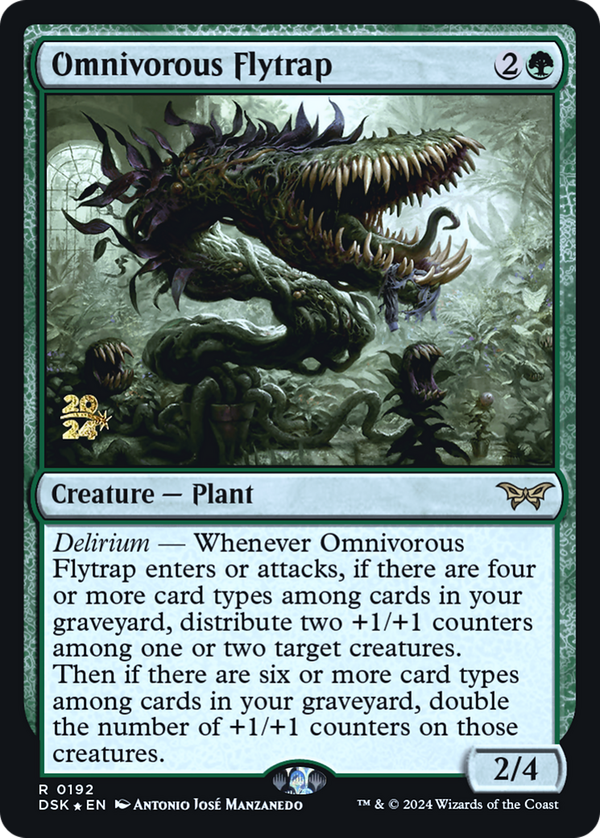
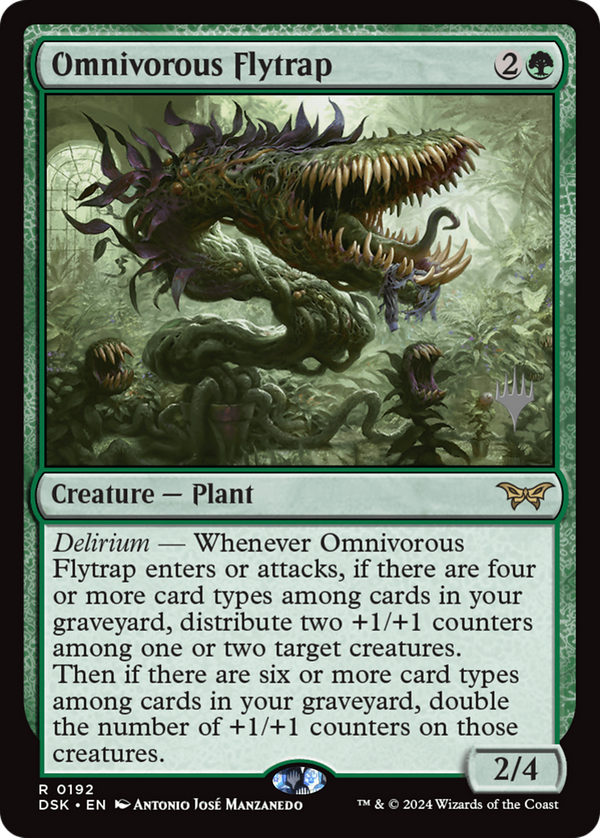
Omnivorous Flytrap


Delirium usually asks for one threshold and pays off once; this design stacks two gates on the same trigger, and the second one rewrites the shape of the reward entirely. At four card types the counters distribute like a normal graveyard-payoff plant. Push to six, and the doubling clause turns the same effect into a genuine snowball: it counts every +1/+1 counter already sitting on the targeted creatures, not just the two you distributed this turn, so a body that has been swinging for a few turns balloons rather than merely growing. Reaching four types is routine for a green graveyard deck; reaching six (creature, instant, sorcery, land, enchantment or artifact, plus something like a planeswalker or battle) demands a deliberately varied graveyard, and it repays that variety on every attack, not just once. The 2/4 frame is the tell: this is an anchor rather than a beater, a body that survives combat while it hands its counters elsewhere, or hoards them on itself when it wants to close. Because the trigger fires on both entering and attacking, the doubling is not a one-shot payoff but an engine, and the discipline it leans on is graveyard diversity rather than graveyard volume, a distinction most delirium cards never bother to draw.