Functionally Golden Egg. The question for TMT is whether a two-mana cantripping rainbow rock earns a maindeck slot in a medium-speed format with fixing already at "good," and the answer is yes more often than not. The fixing is genuine, since the legendary push at uncommon and the hybrid commons reward splashing a third color, and the cantrip means it is never a wasted turn-two play in a deck that has the time. The Food type is a real bonus here: there is a small Food subtheme running through BG and adjacent grindy shells, and a sacrificeable artifact that also draws a card slots in cleanly alongside Anchovy & Banana Pizza. Take it readily in any two-plus-color midrange deck, especially BG and any shell with a splashable legendary uncommon you need to reach. The fastest red decks have less use for the tempo stumble and can leave it for someone who actually wanted it.
Omni-Cheese Pizza

How this card plays
Functionally Golden Egg. In Commander the cantrip-on-entry is what keeps it from ever being a wasted slot, and the rainbow-mana exit ramp is the mode that earns the include in heavy three- and four-color builds where every card that fixes and replaces itself is welcome. Nothing about the singleton format changes the established read: it is smooth fixing for decks that want their fixing to leave behind a card and a sacrifice trigger rather than just sit on the battlefield.
The wrinkle Commander adds is the Food typing. In a Korvold-style sacrifice deck or a dedicated Food shell this is doing more than a vanilla Treasure-equivalent ever could: it is a Food that cantrips on entry, converts to fixing on the way out, and feeds whatever payoff counts artifacts or Food leaving the battlefield. That combination on one cheap chassis is the genuinely unusual part of the card, and it makes Omni-Cheese Pizza a real consideration in any deck built around the type rather than a filler Food you tolerate for the count. For everyone else it is what it has always been: glue.
Functionally Golden Egg. Modern has never had any use for the effect, and a new printing does not create one: the fixing-plus-cantrip floor is too slow for a format that solves its mana with fetchlands and shocks, and the life mode is not a payoff anything is building toward. It is legal but has yet to register in tracked tournament play, which is the correct read for a card that was already a Limited-only commodity in its first home. The Food typing is the one thread worth watching, since a cantripping sacrificeable artifact does more inside a Food-matters shell than the rest of the type, but no Modern Food deck currently wants this over its real enablers. The deck that wanted Golden Egg in Modern did not exist before, and adding a copy to the pool does not summon it.
Functionally Golden Egg, with the same cantrip-plus-fixing floor that made the original a quiet inclusion wherever a deck wanted a free card stapled to a color fixer. Standard does not change the math: the card replaces itself on entry, smooths a splash a turn later, and leaves the life mode as the dead-board fallback.
What Standard offers it is the Food subtheme, where a sacrificeable artifact that also draws a card and produces any color is more than a fixing rounding piece. A sacrifice or Food-matters shell gets a body of value out of the same card a fixing deck treats as a one-shot ramp tool. That is the only real lever this format pulls, and it is a deckbuilding consideration rather than a power bump.
For now it has yet to register in tracked tournament play this season, which tracks with the original's reputation: a clean utility commodity, never a deck's reason to exist. The decks that would want it want it for the same reasons they always did, and they have not surfaced in numbers yet.
The reprint baseline here is the anchor, even though the costs do not line up the way a perfect match would: this is the same draw-and-fix-and-bank chassis players already know, with the mana mode gated behind a sacrifice and a turn of setup. Pioneer runs on deep, cheap fixing, and a two-mana artifact that wants a follow-up turn to convert is a rate the format outgrew long ago. It is legal but has yet to register in tracked tournament play, which tracks: the decks that want one-card draw-and-fix reach for cheaper, faster pieces, and the life mode is a floor nothing in the format is shopping for.
The one thing genuinely new is the Food subtype, and in Pioneer that is upside without a home. The format has no assembled Food-matters deck waiting on another sacrificeable artifact, so the typing sits there as text nobody is building around. If a Food shell ever materializes, a cantripping, mana-producing body that wants to be sacrificed is real fodder. Until then the typing is the only distinction worth naming, and nothing in the format is asking for it.
Registered in 0.1% of tracked decks, 4.0 copies on average. Last seen May 23, 2026.
Functionally Golden Egg. The cantrip-plus-fixing-plus-Food floor that made the original a reasonable splash enabler exists in Pauper too, but the format gives it almost nothing to do. Pauper's fixing problem is solved more cheaply (the common dual lands, Prophetic Prism for the artifact-matters decks, Chromatic Star where you want the sac trigger), and none of those ask you to spend a turn deploying a two-mana rock before you crack it. The result is a fringe card that the data backs up: it shows up rarely, and as a full set when it does, which is the signature of a niche brew leaning on the Food typing rather than a deck that wants the rate. Outside a dedicated Food shell with sacrifice payoffs, the tempo cost is too high for what is, at base, a slow rainbow source you have to retire to use.
Functionally Golden Egg. Vintage does not ask Food for fixing, so the rainbow-mana mode that justifies this kind of card in a creature deck is mostly noise here: the format's fixing is the original dual lands and fast mana, not a two-mana artifact you have to spend a turn cracking. What carries over is the only line Vintage ever cared about on a card like this, the cantrip-on-entry that makes it a permanent costing nothing in cards. That is the slot it could fill: an artifact that replaces itself, sits on the battlefield, and feeds whatever wants Food or wants artifacts in the yard. So far it has not registered in tracked tournament play, and the reason is plain enough. A self-replacing two-mana rock that still demands a turn and a sacrifice to produce its mana is a rate that a format defined by Black Lotus and the Moxen has no room for.
Functionally Golden Egg, the slightly heavier cousin: the cantrip happens on entry, the fixing and the life are sacrifice modes, and the body is a Food. In Legacy that profile has a settled ceiling. Fixing this slow competes with fetchlands, duals, and one-mana rocks, and the formats that want a cantripping artifact want it to be a real engine piece, not a do-nothing that filters one card and a colorless turn. Cracking it costs a full turn of setup plus the activation, which is too much tempo to ask of decks already running cleaner fixing.
It is legal here, but it has not registered in tracked tournament play so far, and that is the honest read rather than an oversight waiting to be corrected. The one place the Food typing earns a second look is a dedicated sacrifice or graveyard-value shell, where a self-cantripping Food that also taps for any color does more than the average artifact fodder. That is a narrow build, not a format pull, and nothing about Legacy's card pool changes the rate the original always offered.
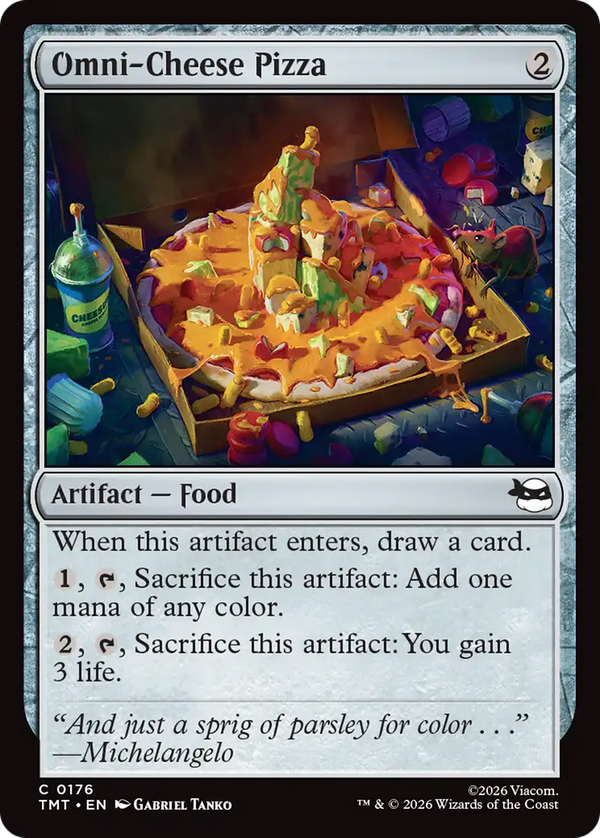
Rules text
 ,
,  , Sacrifice this artifact: Add one mana of any color.
, , Sacrifice this artifact: You gain 3 life.
, Sacrifice this artifact: Add one mana of any color.
, , Sacrifice this artifact: You gain 3 life.