Needlebite Trap


Cast at full price, a seven-mana drain-five is an afterthought, and that's deliberate: the spell is sized to never be paid for honestly. Its real cost is , available only when an opponent gained life that turn, and the gap between those two numbers is the entire mechanism. Lifegain is rarely a board-defining play; it arrives incidentally, off a lifelink connection in combat, a Kitchen Finks blink, a stray triggered gain from some value engine. So the Trap subtype here works as a punisher tuned to its harshest setting: a dead card most of the time, priced as a blowout for the precise moment the opposing deck does the thing it wants to do anyway. Holding up a useless instant on the gamble that one of those incidental moments shows up is a real opportunity cost, and the payoff when it lands is a ten-life swing across the table for a single black mana. That swing reads as theft because it taxes a decision the opponent never thought of as a decision. It is built around an opponent's least-considered play, which is both why it sits unplayed in most hands and why, on the rare turn the condition flips, the cost feels like it cheated the rules of the game.
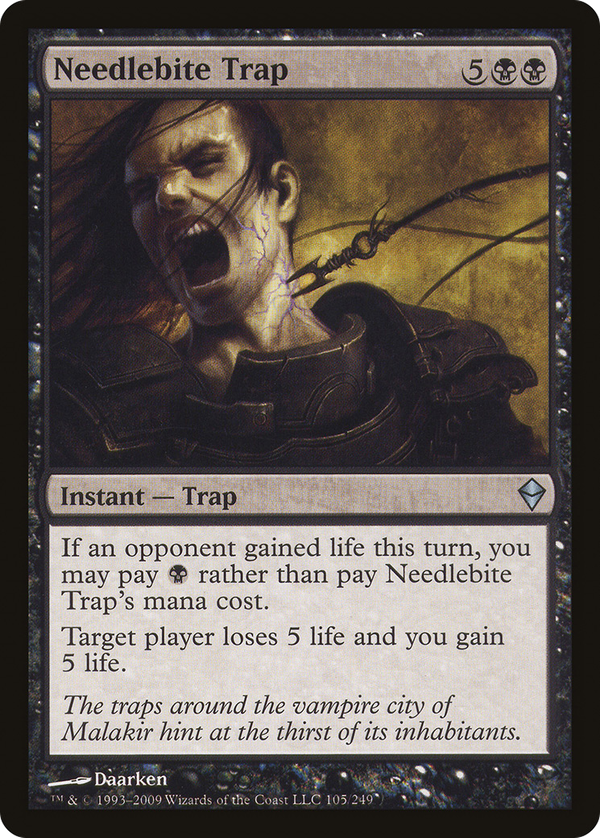
Rules text
rather than pay this spell's mana cost.
Target player loses 5 life and you gain 5 life.