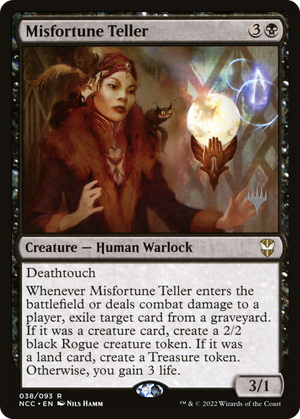
Misfortune Teller


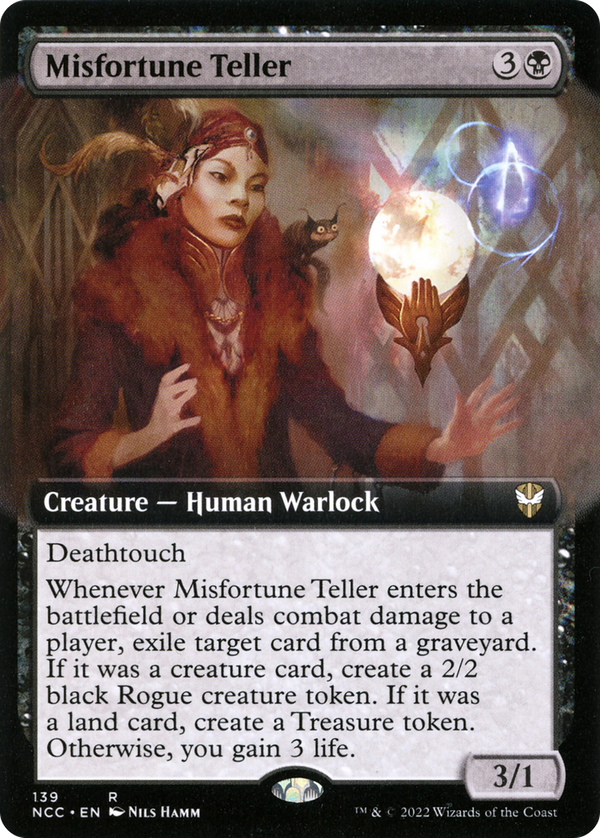
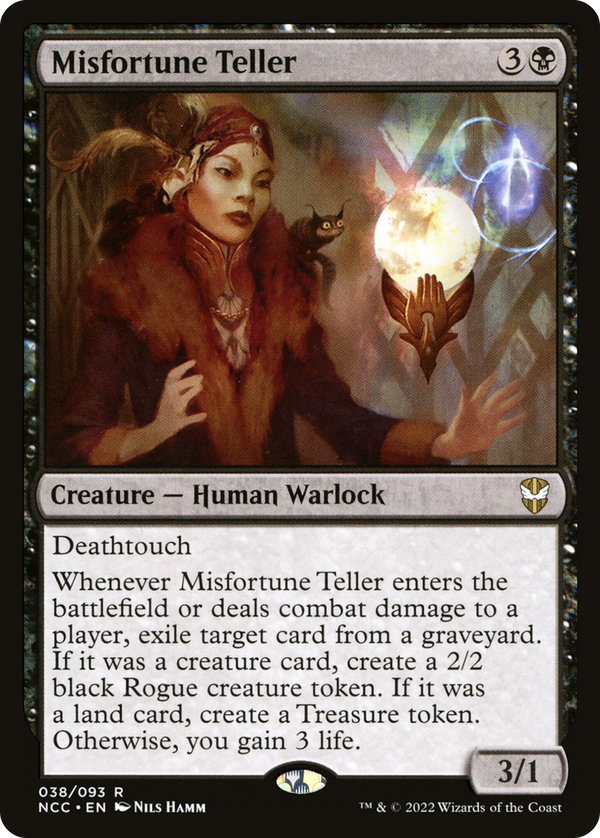
The exile clause is the same every time; the payout is what branches, and that branching is why the trigger rarely reads dead. Feed it a creature card and the graveyard shrinks while a 2/2 Rogue joins your board; feed it a land and you bank a Treasure; feed it anything else and you gain three life. On a table crowded with recursion targets, the reward reshapes itself to fit whatever pile you strip from. What separates this from a one-shot piece of graveyard hate is that the ability fires on two events, not one: it triggers the moment the body hits the battlefield, so you collect a value before combat is even a question, and it triggers again on every connection afterward. That splits the card into a guaranteed opener and a repeatable engine. Deathtouch is quietly holding up the combat half: a 3/1 that kills whatever it touches makes blocking a losing proposition, so opponents tend to wave it through rather than trade a real creature into it, which means the damage trigger fires far more reliably than one point of toughness would suggest. The demand it makes of a deck is modest: the enter trigger asks nothing but a graveyard to point at, and the recurring trigger asks only a willingness to attack. Everything past that is graveyard denial stapled to a creature that keeps connecting, converting a table full of recursion into a slow tax that pays out differently every time it collects.