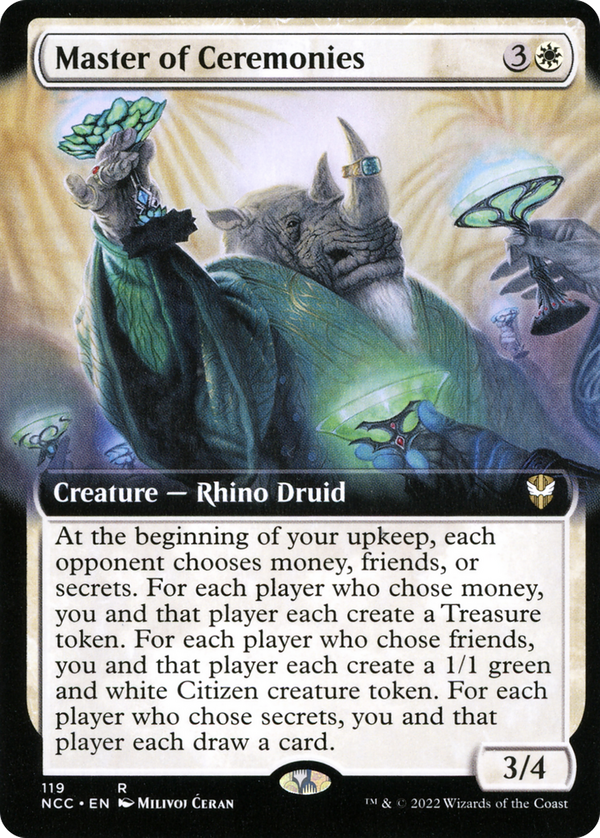
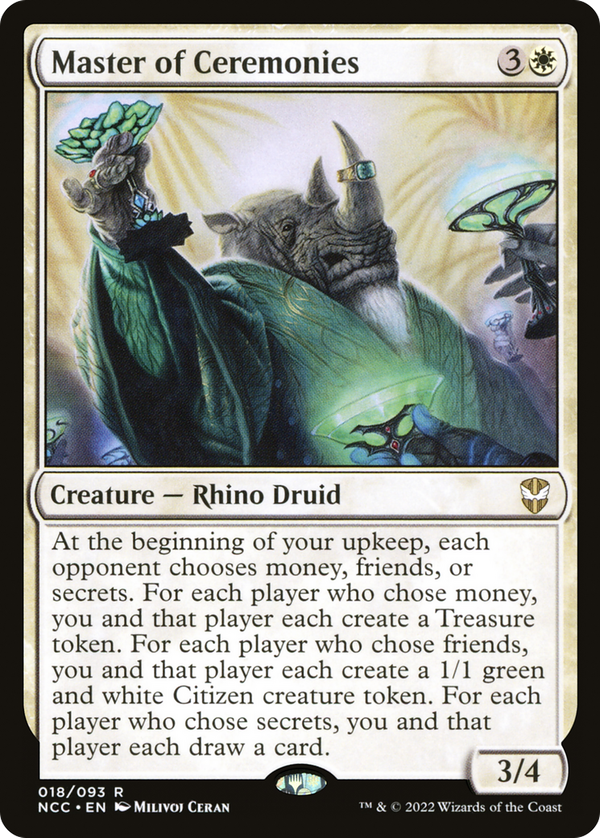
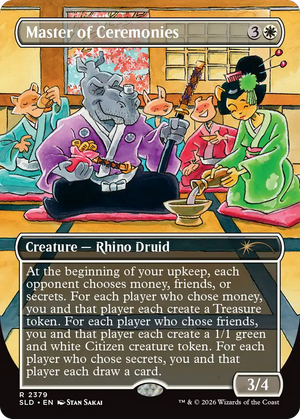
Master of Ceremonies


The whole gimmick lives in the word "choose," and it points at your opponents rather than at you. At the start of your upkeep, every opponent picks a lane: money, friends, or secrets. Whatever they take, you take too, in the same quantity. The design is a symmetry that only looks symmetrical: opponents hand you Treasure, bodies, or cards one at a time, while you rake in the pooled total from everyone at once. In a four-player pod, three opponents each choosing secrets means three cards to you against one apiece to them, and the same arithmetic holds for the ramp and the tokens. The genre this belongs to is the group-gift permanent: political engines that force a decision on the table and profit from the aggregate. The trick is that none of the three options is a punishment, so opponents rarely feel coerced into feeding you; they take what helps their own game and you compound it. That makes it a slow, low-friction engine rather than a threat anyone races to remove, which is exactly the kind of card that survives long enough for the multiplied upkeeps to matter. What balances it is that the payoff is spread thin per opponent and entirely out of your hands turn to turn: you set the table and let the pod decide what shape your advantage takes, once per rotation of the crown rather than every turn of the game.