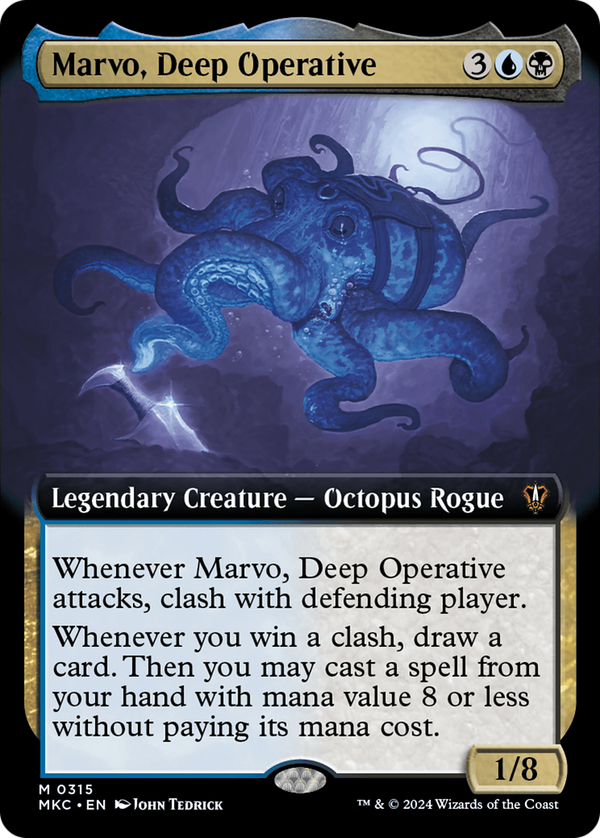
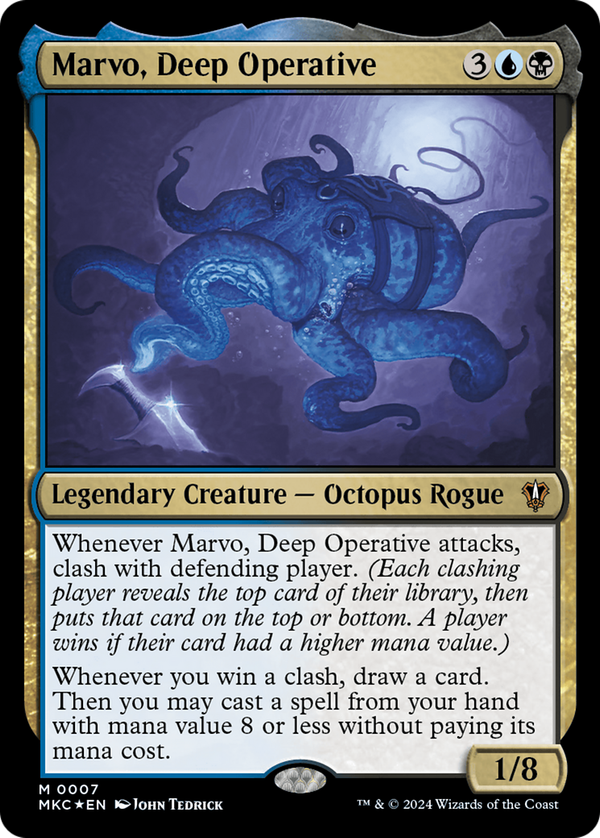
Marvo, Deep Operative



Clash arrived as an early-era top-of-library gamble that mostly fed set-specific payoffs and then went dormant, a coin flip nobody found worth building around. This turns the flip into a free-cast engine, and the body is what makes it work: eight toughness on a single point of power means the octopus attacks into a full board and survives, so the trigger fires turn after turn while nothing profitably trades with it. The clash resolves off the revealed card alone: both players reveal the top of their library, higher mana value wins, and only then does anyone choose whether to keep the card on top or slide it to the bottom. A defending player cannot read their own reveal and duck the outcome after the fact; the winner is locked before the choice to move the card even happens. That sequencing matters because the reward is steep. Win the clash and you draw, then cast something of mana value eight or less from hand for free, which pushes the build top-heavy on two axes at once: expensive spells win the reveal more often and give the free cast a worthwhile target. The friction is that the reveal is never guaranteed, so a low curve can leave you drawing with nothing to cheat out. But note what the payoff does not require. This is an attack trigger, not a damage trigger; the wall never has to connect. Declaring it as an attacker is the entire cost, and it is built to declare over and over.