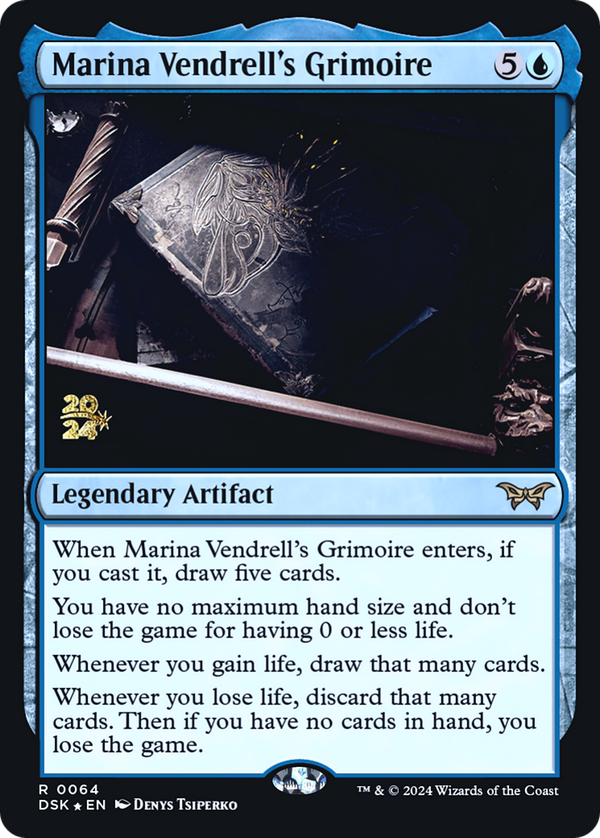
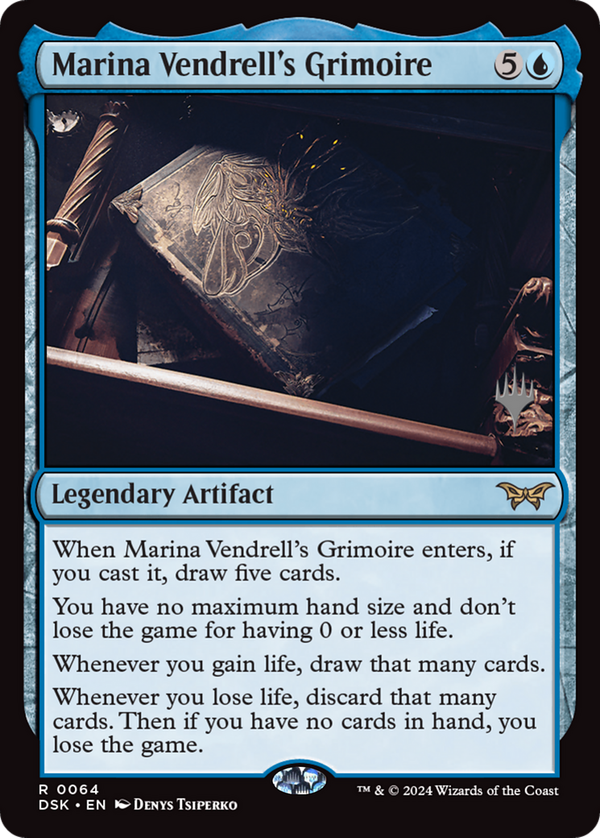
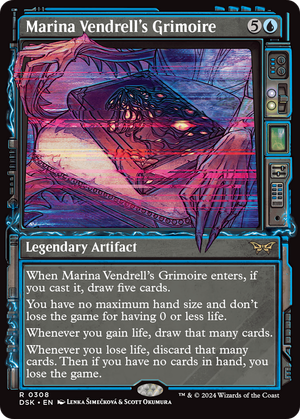
Marina Vendrell's Grimoire


Life total becomes a currency here, not a clock. Most designs that touch lifegain and card draw treat them as separate resources; this one welds them into a single loop where every point of life you swing translates directly into cards, in either direction. Gain life and you draw exactly that many; lose life and you discard exactly that many. The static clause that removes your maximum hand size and your death-from-zero-life fail state is what makes the whole exchange safe to run wide open: you can drop into negative life and keep playing, banking on lifegain to refill both totals at once. But the design plants a new lose condition precisely where the old one was removed. Empty your hand while bleeding life and the game ends immediately, so the deck-building tension is not "how much life can I lose" but "can I keep cards in hand faster than they get stripped away." That inverts how lifegain and life-loss usually feel: a big life swing is no longer a comfort or a threat by itself; it is a draw step or a discard step, and the fragility lives in the hand rather than the life total. It rewards engines that gain and lose in controlled increments over ones that spike, because a single large life-loss trigger can burn through an entire hand and flip the safety valve into a guillotine.