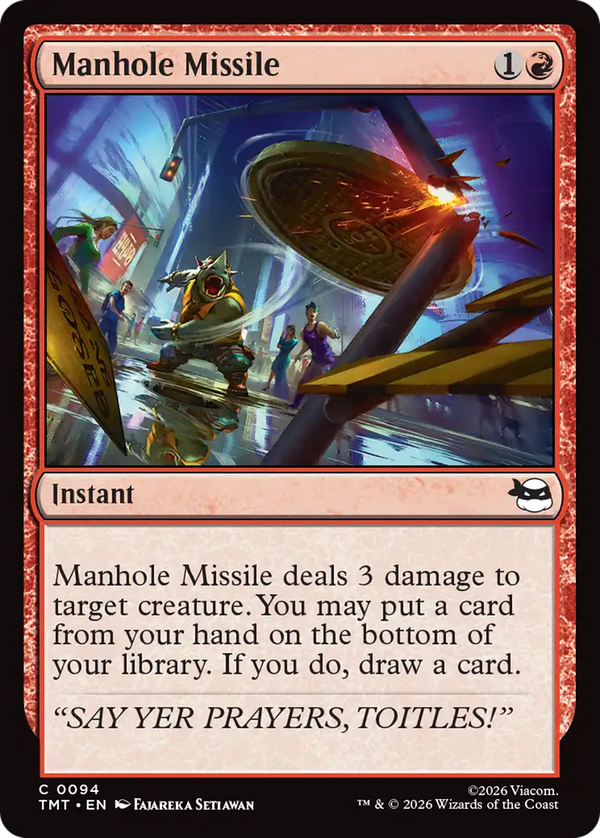
Functionally Fire Prophecy, and in a medium-speed format where the common ground creatures cap out around 2/3 and 3/2 it hits almost everything that matters on rate. The three-damage half answers the bulk of the curve, and at instant speed it lines up cleanly post-combat against the Sneak attackers that want to slip in for chip damage. The filter mode does its work once you have committed to a target: it lets you trade a card you do not need for a fresh draw on the same spell, smoothing toward the answer to a Shredder, Unrelenting or a mythic Turtle before it lands. An early pick in any red seat, the kind of card that points you into red once you see one in pack one. With removal at only medium density overall, a second copy still maindecks happily rather than sitting as a luxury.
Manhole Missile


How this card plays
Functionally Fire Prophecy. In Commander it competes with a deep bench of two-mana red interaction, and the bottom-of-library loot, the line that disciplines it in Constructed, is exactly what dulls it here. The decks that most want a red cantrip-removal spell tend to be the ones running Faithless Looting and friends precisely because those fill the yard; this hands you card selection instead, no fuel, and only on a "may" you will often decline. Three damage also ages poorly against the larger singleton bodies a Commander board tends to field. It is a fine inclusion in a low-curve aggressive red deck that just wants clean answers at instant speed, but in most builds it sits a notch below the removal that either scales with the table or feeds a graveyard engine.
Functionally Fire Prophecy. Modern is the one format where the bottom-of-library clause has weight, since this is exactly the kind of looting Izzet and Mardu shells want to point into a graveyard, and this version refuses to feed it. A Faithless Looting effect that buries the discarded card instead of binning it is the wrong loot for those decks, and the removal mode, three damage at instant speed, is competing for slots that Lightning Bolt and friends already hold at a better rate against the format's small creatures.
It is legal, and so far it has yet to register in tracked Modern play. That is the expected result: the deck that wants two-mana Shock-plus-selection in Modern is hard to find, and the decks that want the looting want the graveyard half this card specifically withholds.
Registered in 0.0% of tracked decks, 1.0 copies on average. Last seen May 16, 2026.
Functionally Fire Prophecy, and the read carries over: a two-mana removal spell that quietly fixes its own draw without ever feeding the graveyard, since the buried card goes to the bottom rather than the bin. That structural discipline is why it can be priced like a burn spell and still smooth your hand in the spots where three damage has no good home.
What Standard does with it is mostly nothing. The card has barely surfaced, and the reasons are environmental rather than a knock on the rate. The creature-only targeting caps it against the format's noncreature threats, and the cantrip mode is marginal smoothing that pays off for a deck already built to hold up instant-speed interaction, not one hunting a reason to add red. When it does turn up it is a lone copy in a shell that already wanted exactly this shape. The pull is the missing piece: a tempo tool that asks you to wait for a target competes with cheaper, less conditional burn in a format that does not reward patience.
Functionally Fire Prophecy. The original's read carries over without amendment: two mana, three damage, and a conditional bottom-of-library loot that prices like a burn spell instead of a card-advantage engine. Pioneer has had Fire Prophecy available the whole time, and this adds a copy to the pool and nothing else. The bottoming clause is the deliberate weak point versus Faithless Looting, which feeds the graveyard decks red usually pairs loot with, so the card has always been a clean tempo-and-selection tool rather than an engine piece. It is legal here but has yet to register in tracked tournament play, which tracks with where the original sits: a reasonable rate that the format's red removal suites have not had room for.
Functionally Fire Prophecy. The two-mana Shock-with-selection rate that made it a fixture in its first format carries straight into Pauper, where the question is whether a removal spell that bottoms instead of bins competes with the format's deep red catalog. It mostly does not, and that is the honest read: Lightning Bolt and Galvanic Blast already do the unconditional damage for one, and the loot-to-bottom mode does nothing for the graveyard-fueled red decks (Kuldotha, Affinity adjacents) that want their discards in the yard, not under the library. The decks left wanting a removal spell that quietly smooths draws are the controlling Izzet shells, and even there the price is steady at instant speed against two-drops it cannot always handle.
Legal, but it has yet to register in tracked Pauper play this season, which tracks with a card whose distinguishing feature, the bottom-of-library clause, is a downgrade in exactly the archetype red loot effects usually serve.
Functionally Fire Prophecy. In Vintage the question is never whether two-mana removal is playable but whether it clears the bar set by the format's free and one-mana interaction, and a sorcery-priced effect at instant speed has a hard time doing that against a field built on artifact mana and busted opening turns. Three damage misses the creatures that actually matter here, and the bottom-of-library mode buys card selection rather than the card advantage or velocity the format rewards. It is legal, and it has yet to register in tracked tournament play this season, which is the expected result rather than a surprise: nothing in this format wants a fair red removal spell that neither pressures the stack nor interacts with artifacts.
Functionally Fire Prophecy. The bottom-of-library clause keeps the loot from feeding a graveyard, which is exactly why this never wanted into the formats that loved Faithless Looting; it is a clean two-mana removal spell that quietly fixes a dead draw, not an enabler.
Legacy is the question, and the honest answer is that three damage at sorcery-adjacent value does not clear the bar a format this fast and this deep in removal sets. Burn would rather point the damage at a face, and the tempo decks that might want instant-speed interaction have access to harder, cheaper answers. It is legal but has yet to register in tracked tournament play, and nothing about the rate suggests that changes. The card selection is real, but Legacy does not pay two mana and a card for selection stapled to a Shock.