Maestros' Totally Safe Hideout
Casualty was built for the stack: paste it onto an instant or a sorcery, feed it a two-power creature, and you get a second copy of the spell, a clean tempo trade where the sacrificed body is the price of doubling one stack object. Grafting it onto a Grixis tapland bends that math into a different shape. Here the thing being copied is not a spell that resolves and dies; it is a permanent mana source, so sacrificing a creature on entry converts a body you were probably finished with into a second, permanent land. Ramp normally charges you a card or a turn of tempo up front. This one takes a creature nobody was using and pays out a fixed source that never leaves. What keeps that trade honest is the tapped clause: the original enters tapped, the copy enters tapped, and the sacrifice fires on entry rather than at your convenience, so the land development lands a beat behind the creature you spent to get it. The winking name and the mock-fortified Maestros safehouse dress it up as a gag, but the design question underneath is legitimate: does casualty, a mechanic tuned for one-shot spell value, still function when the thing it duplicates is a lasting resource instead of something that resolves and leaves? It does, and it behaves nothing like its instant-speed relatives, which is the sort of remix a mechanic-shuffling product exists to run.
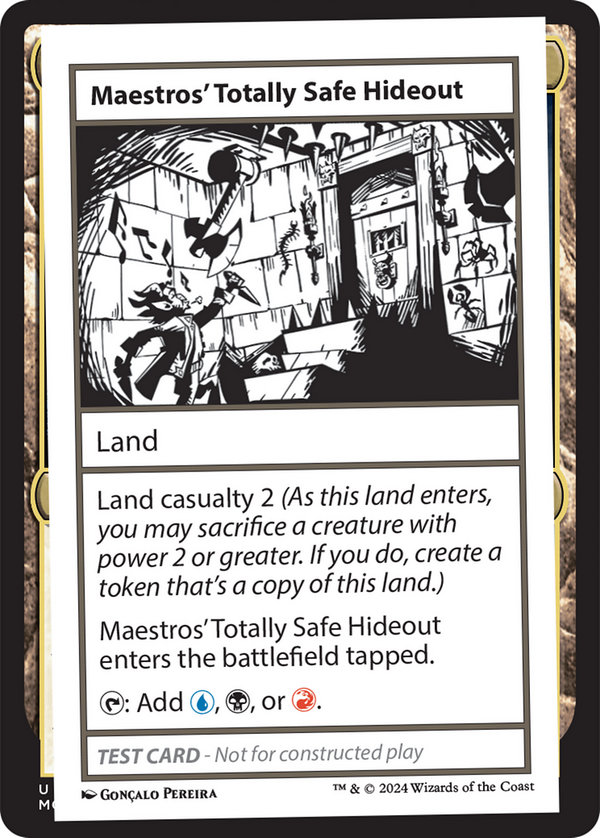
Rules text
 : Add
: Add  ,
,  , or
, or  .
.