Long-Range Sensor


Discover on a stick usually costs a spellcast; here it costs a swing. The charge-counter economy reframes what Discover pays for: instead of chaining off a cast trigger, you bank counters by attacking players, then convert two of them and a single mana into a cascade-style dig for four. That coupling is the whole design tension. It wants a board that attacks every turn, but it feeds card advantage rather than combat damage, so it rewards a deck already committed to going wide or going face while quietly refilling the hand. The sorcery-speed restriction closes the obvious loophole (no attack-step activations, no combat-trick value from the free spell), keeping the payoff on your own main phase where you can actually deploy what Discover surfaces. And because charge counters accumulate rather than reset, the artifact scales with how long the game runs: a single successful attack pattern eventually stockpiles enough to fire the ability multiple times. Structurally it belongs to the small family of artifacts that turn a combat keyword-adjacent trigger into a repeatable engine, but the specific marriage of attack-trigger fuel and free-cast Discover is what gives it an identity beyond generic value. It is built for the aggressive multiplayer deck that wanted a reason to keep attacking after the alpha strike stopped mattering.
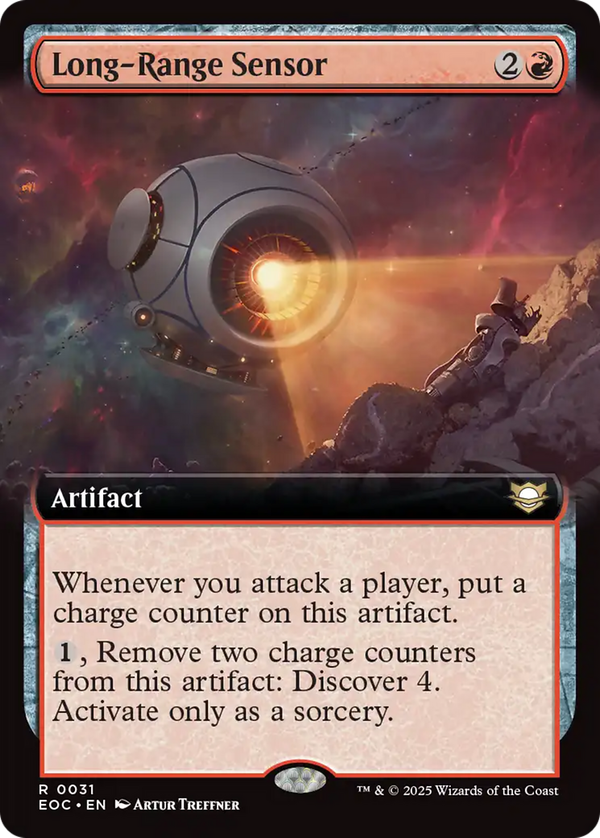
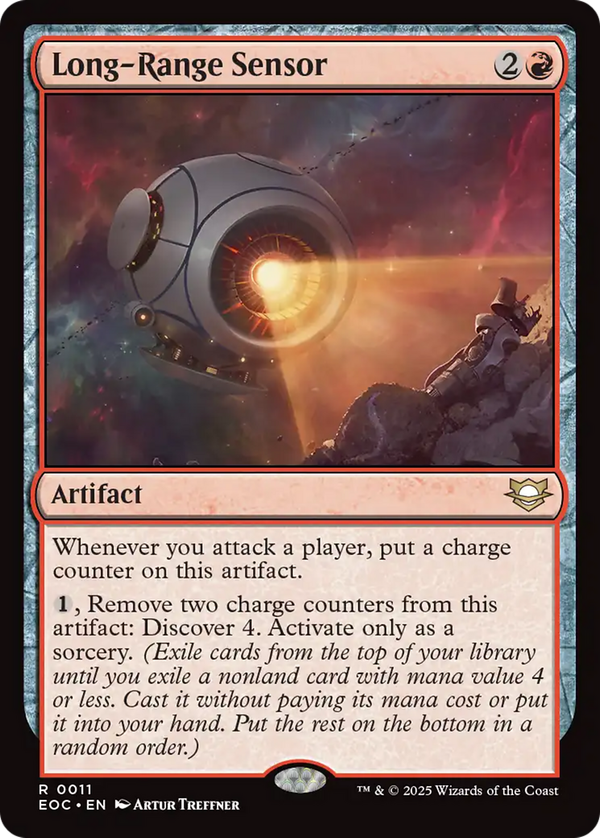
Rules text
 , Remove two charge counters from this artifact: Discover 4. Activate only as a sorcery. (Exile cards from the top of your library until you exile a nonland card with mana value 4 or less. Cast it without paying its mana cost or put it into your hand. Put the rest on the bottom in a random order.)