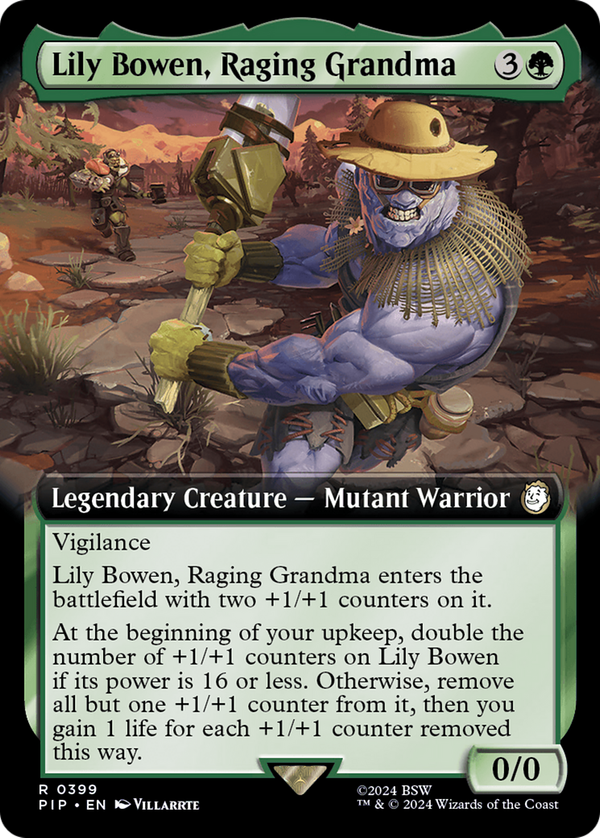
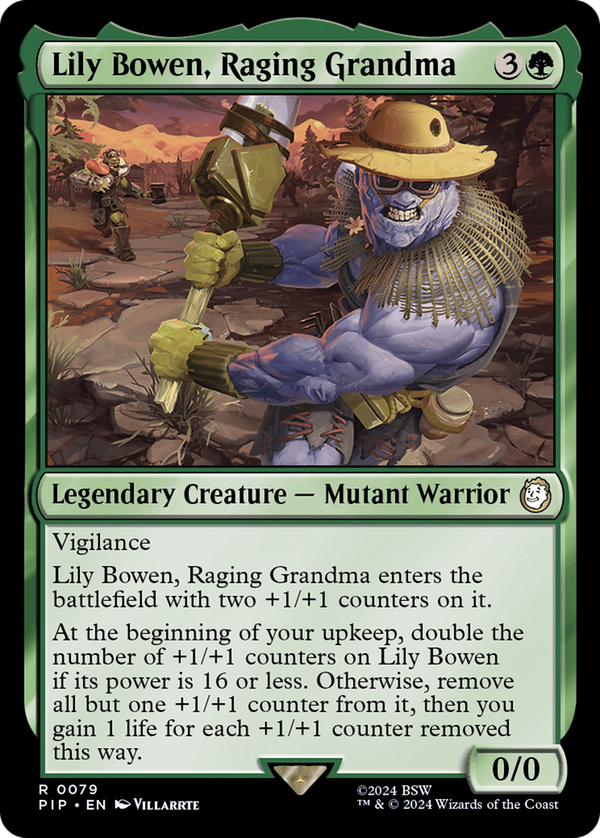
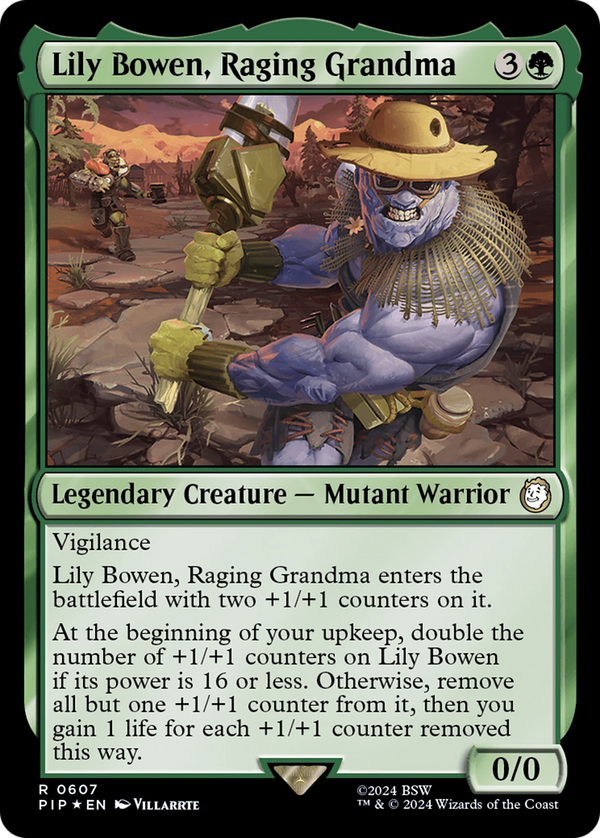
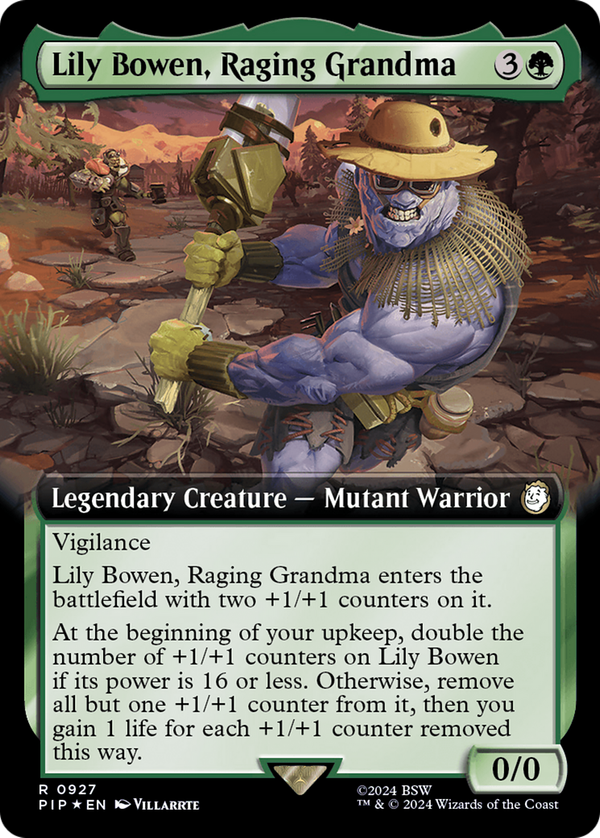
Lily Bowen, Raging Grandma


The doubling clock is the whole design conceit, and it runs on a deliberate ceiling. Two counters become four, four become eight, eight become sixteen: three upkeeps to a 16/16. The threshold check reads "if its power is 16 or less," so a 16/16 still qualifies and doubles once more to a 32/32. Only on the following upkeep, at power 32, does the engine trip: it strips all but one counter and hands you thirty-one life, converting a bloated single threat into a fistful of life and starting the ramp over. That reset is the balancing act. The payoff for pushing the counters isn't an unbounded creature; it's a hard stop that cashes your investment out and begins again from one, a body that goes tall fast but refuses to spiral infinitely. Vigilance matters more than it looks, because a doubling clock is worthless if attacking strips your only blocker; here Lily swings and defends on the same turn, so every upkeep of growth is also a growing wall. And the exponential curve means the numbers get silly quickly: the gap between a 4/4 after one upkeep and a 16/16 after three is enormous, which turns any counter manipulation (proliferate, an outside doubling effect, a way to add counters at instant speed) into a lever on a curve that's already steep. What the card asks for is patience and protection, not a combo; the reward is a threat that rebuilds itself the moment it overshoots.