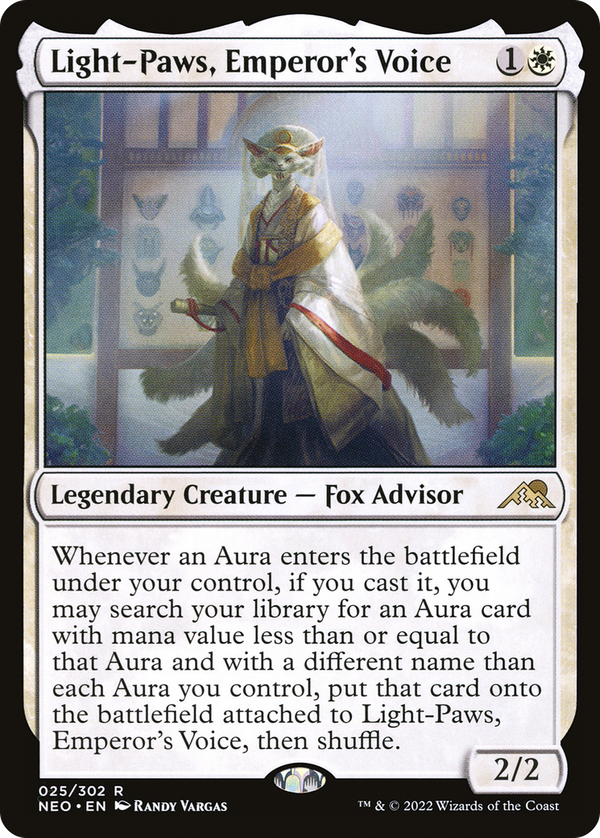
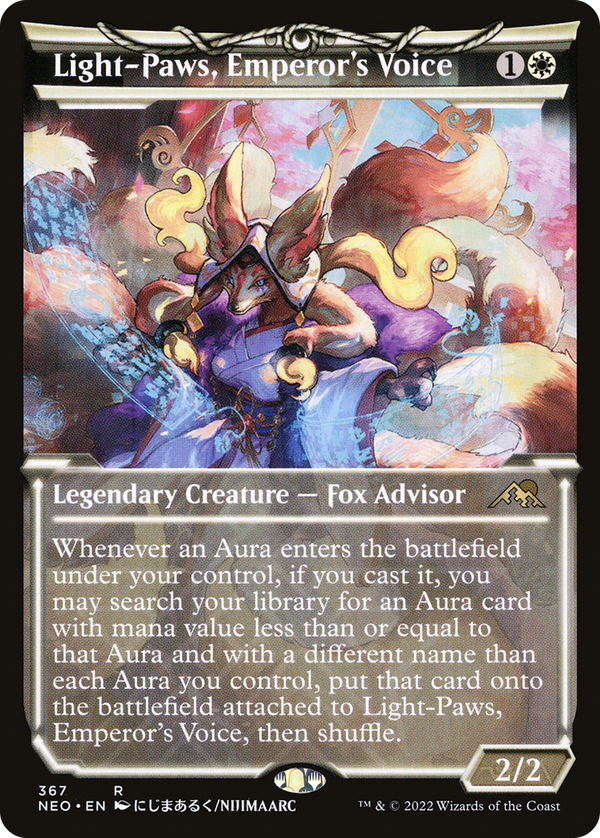
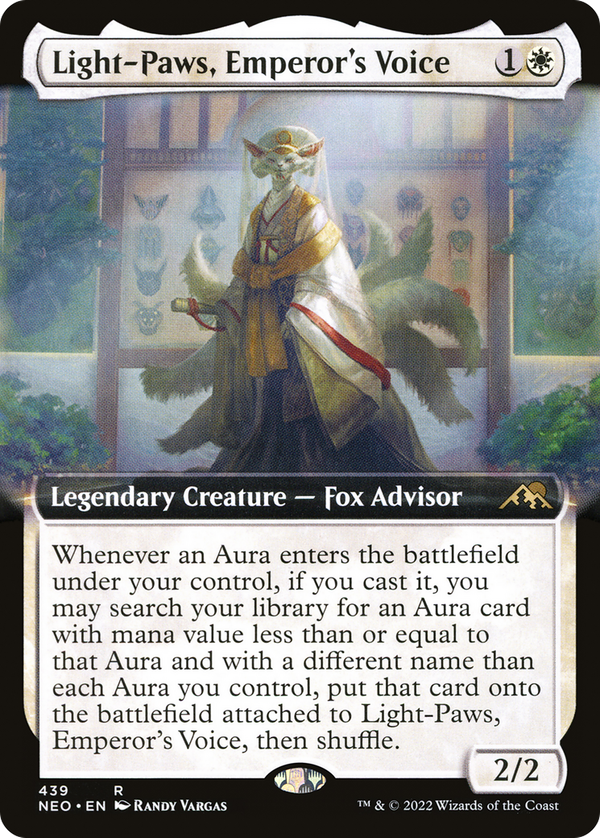
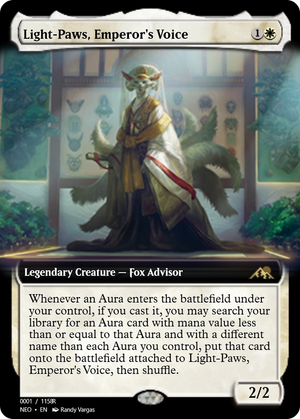
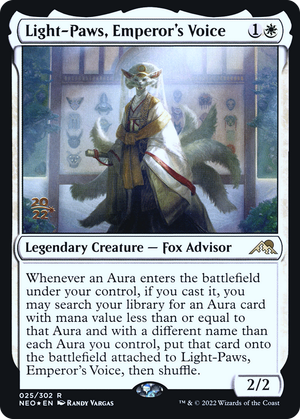
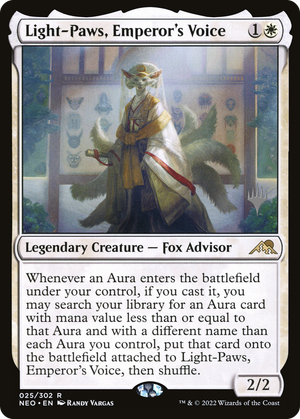
Light-Paws, Emperor's Voice


An Aura you control entering after being cast is the trigger, and the tutor it fires is the engine's whole discipline: the fetched Aura has to cost no more than the one you just cast, and it has to carry a name none of your other Auras share. Those two clamps are what shape the deck. Because the tutored Aura enters attached rather than cast, it does not trigger this ability again, so a single hard cast yields exactly two Auras: the one you paid for and the one you dug up. The chaining, then, is horizontal, not vertical. Every Aura you deliberately cast fetches a partner, and over a game the descending mana-value clause lets you spend your casts on progressively cheaper enchantments while still pulling something useful off the top each time. The name clause is the real ceiling: it forbids stacking copies of the same buff and instead rewards a spread of cheap, differently-named Auras, so the pilot assembles a toolbox rather than a redundancy pile. That turns each Aura in the deck into a threat-density lever, since one card in hand quietly represents two on the board. The vulnerability is baked into the same premise: a value creature whose payoff lives entirely on its own back means one well-timed removal spell doesn't just kill a 2/2, it strands the whole enchanted stack in the graveyard. That fragility is the tax the design pays for letting a two-drop convert one spell into two permanents attached to a body.