Light of Hope

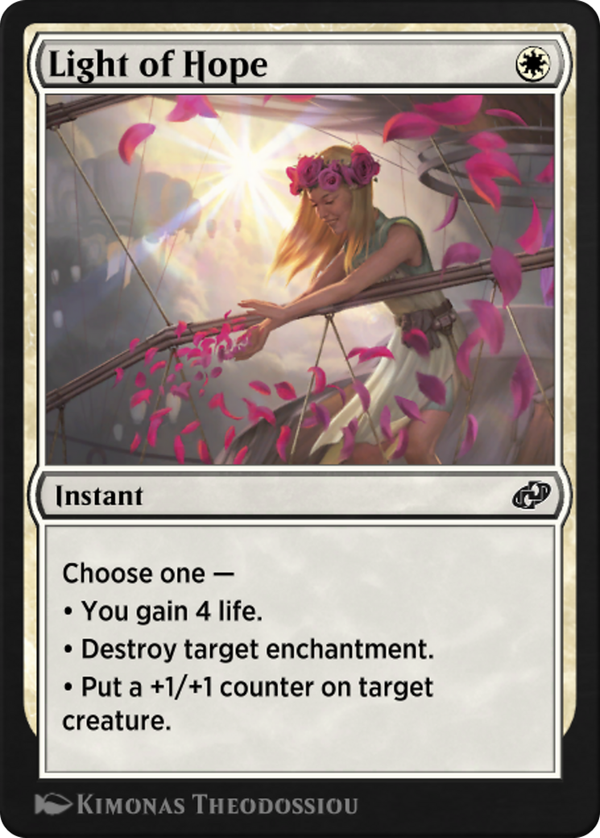
The modal instant that trades certainty for flexibility, and the choices it offers reveal how carefully white's utility spells are budgeted. Each mode is intentionally underpowered against a single-purpose card at the same cost: four life is a hair below what a dedicated lifegain spell gives, single-target enchantment removal is narrower than the sweep effects white usually reaches for, and one +1/+1 counter is a modest combat bump. Priced together on one card, though, those three modes cover three unrelated situations a deck rarely wants to spend three separate slots insuring against. The value here is not any single line but the reduction of dead draws: an enchantment-destruction card is useless in a game with no enchantments, but this one always has a floor because you can gain the life or grow a creature instead. Instant speed matters most on the removal mode, letting you answer a problem enchantment on the opponent's turn or hold the card up as a combat-trick bluff and cash it in for the counter if the swing never comes. This is the modern shape of a long design lineage: the small, cheap answer that hedges against variance rather than dominating any one axis. It asks nothing of your deckbuilding and rewards nothing in particular; it simply refuses to be a wasted card, a quieter form of efficiency than raw power.