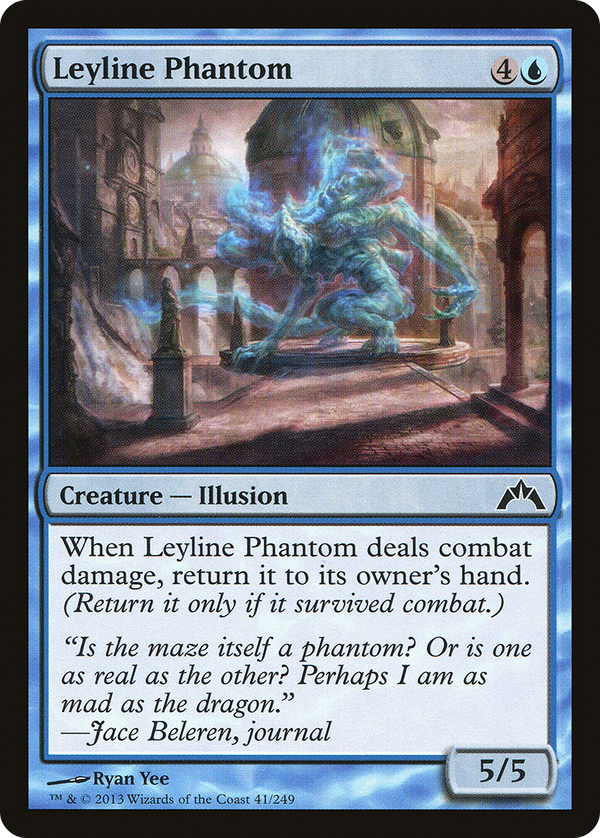
Leyline Phantom


The bounce clause reads like a drawback, and on a worse creature it would be. Here it is the price the rest of the card pays for being a 5/5 attached to a built-in escape hatch. Connect with an attack and the Phantom flickers back to hand, where no removal can touch it: a 5/5 you can keep replaying is harder to grind out than a 5/5 that sits and waits to be answered. The recursion makes it a recurring threat rather than a permanent board presence, a strange shape for a creature this big. The tax is real, though: with no flash and no haste, every replay costs five mana again and a turn of summoning sickness, which means the Phantom has to survive an opponent's turn on the battlefield before it can swing, exposed to removal in the window the bounce was supposed to dodge. Illusions of this era leaned on a too-good body undercut by a single sharp clause (the sacrifice-on-target trigger of Phantasmal Bear and its kin); the self-bounce is a gentler tax, costing tempo rather than the creature itself. The catch lives in the parenthetical: the bounce only fires if the Phantom survives combat, so an instant-speed kill spell in the combat step, or a blocker big enough to trade, leaves nothing to return. A chump block does not help; the Phantom kills the blocker, survives, and bounces all the same. Trading up to a 5/5 is the only honest answer, and that is rarely cheap.