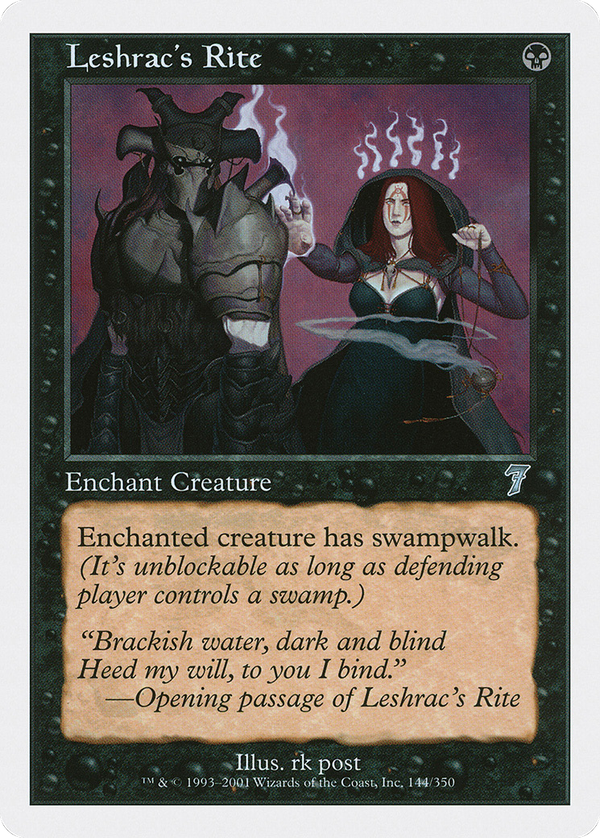
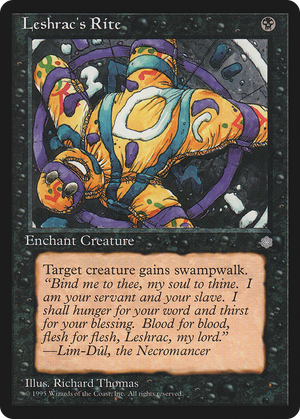
Leshrac's Rite

Landwalk auras are the genre's most honest admission of a design tradeoff: power that exists entirely at the mercy of the opponent's manabase. The black-mana price tag here is about the floor for the math, and it has to be, because swampwalk only matters when the defending player happens to control a Swamp. Against another black deck it is a clean unblockable enabler; against a player with no basic or nonbasic Swamps in sight the aura sits inert on the creature, a tempo loss with no upside. That gap between best case and worst case is the whole identity of the effect, and it explains why landwalk auras have always lived at the margins. The card-disadvantage problem common to all Auras (lose the creature, lose the enchantment, fall two cards behind) compounds the conditionality, so the rate is forced cheap to justify the risk. What the keyword encodes is evasion as color punishment: the swamp clause makes the aura's value a direct function of how heavily the opponent has committed to black mana, which is a property of who is across the table rather than of the card itself. That dependency is exactly why landwalk as a category quietly receded as Magic shifted toward evasion that does not ask permission from the other player's lands.