Lembas

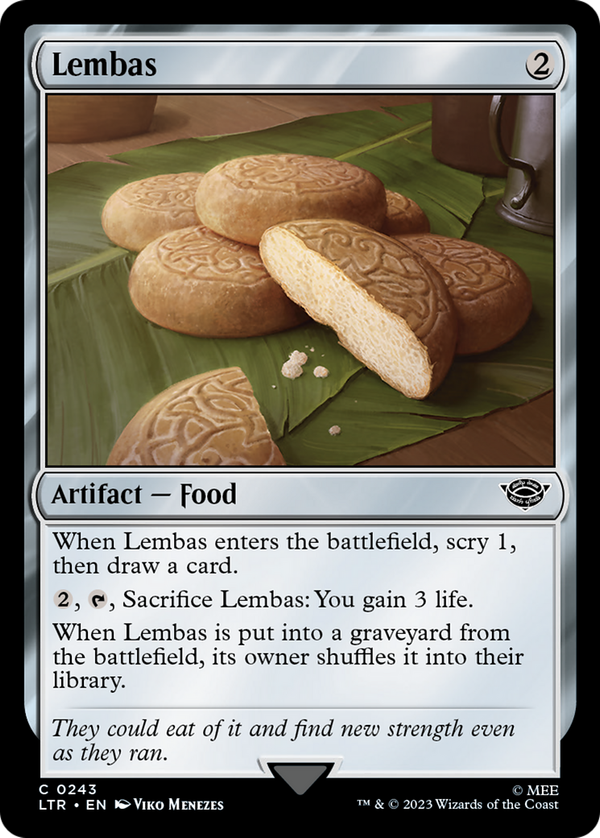
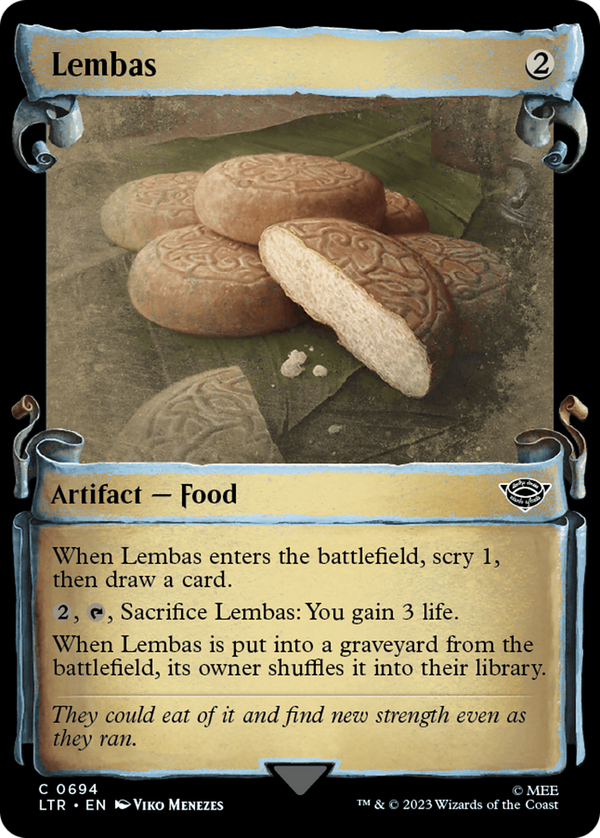
Most Food is disposable by design: it exists to be sacrificed once for a fixed chunk of life and then leave the game. The last clause here quietly refuses that fate. Instead of hitting the graveyard when spent, it shuffles itself back into the library, so the card is never truly gone; it just goes back to being one of the cards you might draw later. That is a meaningfully different balancing lever from the buyback-style recursion it superficially resembles. There is no loop, no way to redeploy it on demand, and no guarantee you ever see it again this game. What you get is a Food that keeps re-entering your deck as a live topdeck, and each time it does hit the battlefield it pays a small cantrip tax on the way in, smoothing your next draw before it draws you a card. The life gain, then, is almost the least interesting thing about it. The real character is a value trinket that can appear more than once across a long game without you spending sideboard or graveyard resources to bring it back: attrition insurance rather than a repeatable engine. The friction is that the return is random and the timing is not yours to choose, which is exactly what keeps a recurring cantrip-plus-lifegain from being oppressive. It rewards grind because it survives grind, not because it can be looped.
Rules text
,  , Sacrifice this artifact: You gain 3 life.
When this artifact is put into a graveyard from the battlefield, its owner shuffles it into their library.
, Sacrifice this artifact: You gain 3 life.
When this artifact is put into a graveyard from the battlefield, its owner shuffles it into their library.